Showing posts with label school event. Show all posts

Too duel for school: Five Questions with Elys Dolan and her glossy steed

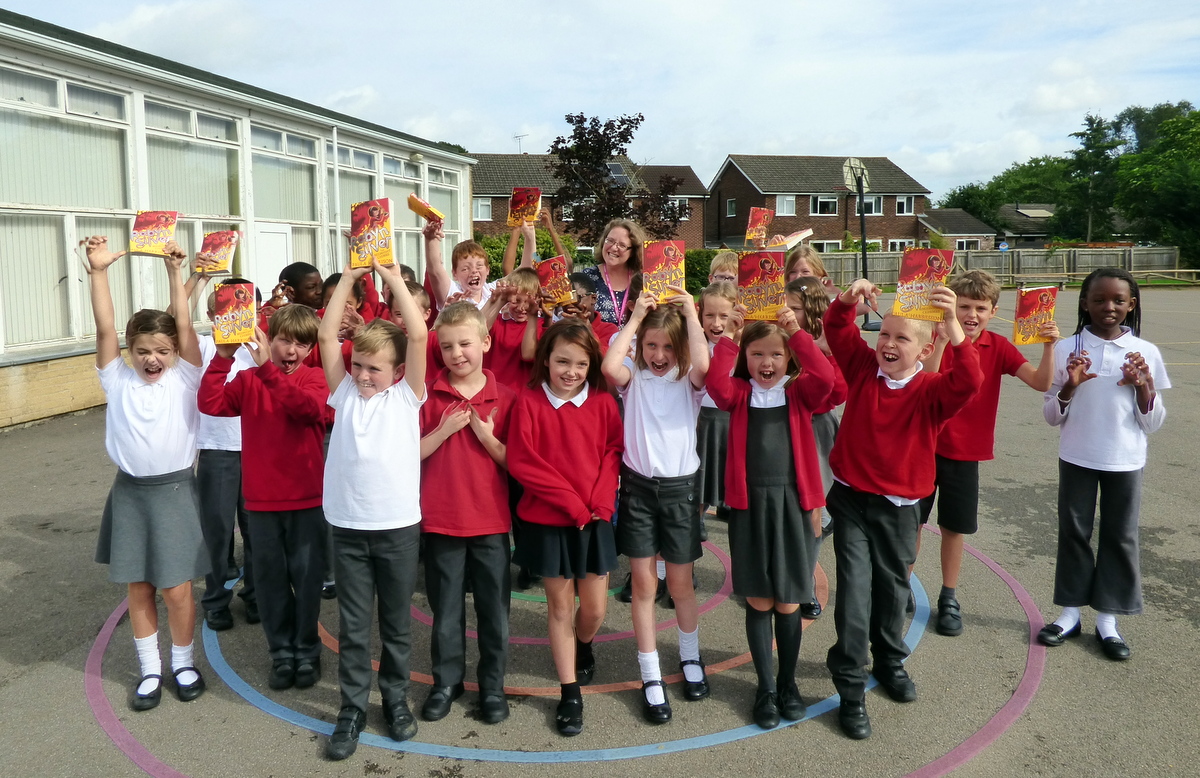
On Friday June 23, we welcomed Elys Dolan to Abingdon, and to Thomas Reade Primary School, where she spent the day talking detective seagulls, glossy steeds and rubbish dragons called Dave with some very enthusiastic - and riveted - children throughout the whole school

Elys had travelled over from Cambridge (on an epic UK tour which saw her in Newcastle and Brighton in the same week).


On her website her interests were declared as 'growing cacti, collecting pocket watches and eating fondant fancies' but it's obvious that what she loves more than anything is to draw.

During each session, the children called out characters to draw, and were enthralled as she brought their suggestions to life on paper in front of them. We had robber squid, a knight with cactus armour - and another knight riding a snow leopard.


Her latest book is called 'Knighthood for Beginners', and is all about Dave, a truly terrible dragon. (That's 'terrible' as in 'rubbish').


Dave is hopeless at dragony things, so when he finds a book called Knighthood for Beginners he decides to learn how to be a knight instead. Dave sets out on a quest with his trusty steed, Albrecht the goat (who scores highly on the 'glossy' stakes), to be brave, chivalrous, and knightly, even up against Sir Gnasty, who scoffs at the idea of a very small, strangely green knight.

Duels are fought, quests are begun...and some fetching knitwear is created...

Here is one of the groups learning to draw 'Steven Seagull', the maverick gull and ex-cop called back to the force to crack a particularly perplexing beach mystery.


This was also the first school event with new owner Sarah Dennis is attendance. It was a lovely event to mark the transition!


Whilst we knew that Elys works predominantly with ink, newfangled digital technology and coloured pencils (of which she is the proud owner of 178) we didn't know much else. Cue five questions to discover more...


1.    What are you working on at the moment?

I'm currently working on a sequel to 'Knighthood for Beginners'. It's another adventure with Dave and Albrecht, onyl this time involving magic and titled 'Wizarding for Beginners'. Cue lots of talking animals and bears. I'm also doing a picture book, similar to 'Mr Bunny's Chocolate Factory' only involving Santa and his workshop. I'm also working on something else - but I can't tell you 'cos it's a secret!

2.    What is the best writing (or drawing) tip you’ve ever been given?

I can give you a tip for drawing: draw things from life. Even if the final picture you end up with isn't realistic, it teaches you to draw what you are seeing, and teaches you to really look at things and observe. And sometimes the details you see end up being what you put into the stories.

3.    What’s the best thing and the worst thing about being a children’s writer?

The best is definitely that writing for children gives you a licence to write about anything, be as silly as you like. The sheer amount of pants in stories might be something frowned upon if writing for adults! The worst is colouring the spreads. For a picture book, at about 3, things are fine but by the time you get to spread twelve or thirteen you are thinking "why is this taking so long?!"


4.    Do you have a writer’s survival kit, eg a place, thing or snack essential before you can start work?

(Thinks) I'm a big fan of snacks, definitely. And you can't go wrong with a cup of tea. But to be honest, give me a paper and pencil and I can pretty much work anywhere.

5.    What was your biggest breakthrough?

When I first started to write picture books, I spent a lot of time putting in elements that I felt should be in a picture book, and the result was a bit of a Frankenstein's Monster. Once I started to have the confidence to develop my own style, and make stuff that I liked and wanted, it turned out that other people liked that as well!

A silver tongue and a monster imagination: Paula Harrison, Robyn Silver and The Midnight Chimes

Paula gets the 'rock star' treatment from the children!
A girl who is born on the stroke of midnight and inherits the power to see what no-one else can see – that the world is full of monsters! – is the gripping premise behind Paula Harrison’s latest book, ‘Robyn Silver the Midnight Chimes’.

Paula Harrison visited Dunmore School and Rush Common School in Abingdon to talk about her book and the inspiration behind it. 

Robyn Silver come from a large family and is well-known for being clumsy – but sometimes she isn’t just making a mess sweeping cobwebs, she is actually fighting monsters - but no-one else in her family can see.

When Robyn’s school moves to a big spooky house in the town, Robyn teams up with two other friends from school, Aiden and Nora, also born on the stroke of midnight and realises she is not alone in seeing all sorts of invisible creatures.

A horrifying 'Blug' was just one of many extremely
scary monsters hatched by the children!
They team together to learn fighting skills in secret, but the biggest threat comes not from an invisible monster, but from a monster who has learned to become visible.

Paula said her favourite part of writing the book was dreaming up the monsters and these are brilliantly brought to life by illustrator Renée Kurilla, who also did the compelling bold jacket.

Paula is a good friend of Mostly Books, having visited the shop for the launch of her mega-selling Rescue Princess series, and also involved in the Nosy Crow takeover of the shop back in 2013.

The children at both Abingdon schools enthusiastically joined in creating their own monsters, giving them everything from superpowers to stilettos and inventing mixed-up monsters that would give everyone a scare if they found one hiding under the bed.

The second in the Robyn Silver series is due next year and is perfect for young fantasy readers.

Paula Harrison is best known for the Rescue Princess series for younger readers, as well as the Red Moon Rising series (about an ordinary girl who discovers she has faerie powers) but said she had always wanted to write a book about monsters.

But where in Paula's brain do these monsters come from. We thought we'd better ask a few more questions...

Five questions with...Paula Harrison's Writing Life

1. What are you working on at the moment?
I am working on the next Robyn Silver story, a yet untitled, which will be out in June, and I am working on another series for younger readers which is based on the idea of the Prince and the Pauper where two girls look identical but are from very different backgrounds. They get involved in lots of mysteries.

2. What is the best writing tip you’ve ever been given?
Just do your own thing.

3. What is the best thing and the worst thing about being a children’s writer?
The best thing is you can make anything into a story. The worst thing is too many ideas and too little time.

4. Do you have a writer’s survival kit, eg a place, snack or other essential thing you need before you start work?
I have certain music I play that matches the mood of the characters and I play that beforehand. Then I sit down at 8.30 and work until lunch and then go for a walk and then work until the children return from school. I do tend to stride around the room trying to solve a problem, so it probably does not look very productive.

5. What was your biggest breakthrough?
Having my first rescue princess book picked up off the slush pile by Nosy Crow!

Thank you so much to Paula for travelling to Abingdon, and to both schools for making her so welcome. We've have some fantastic reviews already in the shop from children who've read 'The Midnight Chimes', so if you want to discover more about Paul and her other books, we'd love to see you!


In space no-one can hear you eat chocolate: five questions with Cas Lester

Last Thursday we were delighted to support a visit to Our Lady's Abingdon by children's author Cas Lester, author of the 'Harvey Drew' space stories, 'Nixie the Bad, Bad Fairy' and, most recently, 'Wilfred the (Un)Wise'.

Cas spoke to children from five different schools over three separate sessions throughout the day (itself an achievement!) and explained her journey to becoming an author, and where the ideas for her stories came from.

The children were fascinated to learn Cas started her career as a children's author after an incredibly successful career making children's TV drama for CBBC (including 'The Story of Tracy Beaker').

Her first book, 'Harvey Drew and the Bin Men from Outer Space' is a madcap story about an ordinary school boy who - via a malfunctioning app and an intergalactic communications screw-up - becomes Captain of the Toxic Spew and its stroppy, bickering, pizza-obsessed crew, and a very bad-tempered central computer. Thanks to some remarkably similar experiences managing a school football team (!) Harvey soon starts to take control of this bunch of alien misfits. (Via lots of space-based, rubbish-related, seriously smelly adventures, obv). 

To an audience of over 250 children, Cas explained the very real problem of space junk, bringing with her plenty of objects imagined lost in space and led the children through a raucous quiz on their space knowledge that got them thinking about the very real challenges of waste in space (not to mention trying to do a 'Number 2' in low-earth orbit...yes, exactly)

Cas also spoke about her latest books. In 'Wilfred the (un)Wise', a young magician from the middle ages who gets pitched forward in time. He has to team up with a young girl in the 21st century, who has set her heart on learning cool street magic. Between them can they pull off magic good enough to get Wilf back to his own time?

Troublesome magic is also the theme of Cas's series for younger readers, the first of which is 'Nixie the Bad, Bad Fairy'. Nixie is no ordinary fairy - she's usually slightly grubby, she's often naughty and she has a very mischievous wand. Nixie's adventures are perfect for anyone just learning to read independently.

Cas is a local author and works brilliantly with all sorts of schools, introducing readers to her wonderfully imaginative, chaotic stories.

This was the first time we had a chance to be up close and personal, so Nicki Thornton grabbed the chance to find out all about the hugely talented and hard-working Cas and her writing life...

Five questions with...Cas Lester's Writing Life

1. What are you working on at the moment?

That is quite hard because I’m not supposed to talk about it. It’s a story about a rather different friendship and it is coming out with Piccadilly next August, but it’s a top secret project so I can’t say any more!

2. What is the best writing tip you’ve ever been given?

Don’t give up.

3. What is the best thing and the worst thing about being a children’s writer?

The worst thing about being any sort of writer is you are doing it on your own and you can be quite isolated. But the best thing about being a children’s writer is that you go out and do lots of events and you meet all the lovely children and it’s wonderful to have that great contact with your readership.

4. Do you have a writer’s survival kit, eg a place, snack or other essential thing you need before you start work?

Chocolate, space and a dog. 


For the first time I actually have an office and my dog will come and lie down next to me, which is very settling. Then after a while she will sigh and jump up and go and get my walking boot. I used to be able to work anywhere and can cope with noise except for two things I can’t work through – a child crying and a single fly buzzing.

(Cas also confessed to a drawer full of chocolate - the dangers of being interviewed with your daughter present).

5. What was your biggest breakthrough?

I don’t know if there was a moment when I thought I can now talk about myself as a children’s writer. It wasn’t my first book or even the first time I signed a book because when you first become a published children’s author you feel that you are really a fraud. But I think it might have been when I heard I had only sold one less book than Brian Blessed at the Chipping Norton Literary Festival.

Maths can be Murder - Five questions with Kjartan Poskitt

If your school ever does an event with Kjartan Poskitt, and you ever get a chance to volunteer to go up on stage with him - think very carefully. During two sessions at Our Lady's School today - involving children from four different primary schools in Abingdon - children eagerly rushed up on to the stage to discover they were going to be poisoned, shoved bodily through a greetings card, or asked to perform a variety of strange and bizarre activities.

Well obviously, not actually *poisoned*. The game called poisoned chocolate didn't actually contain real poison (or, sadly, chocolate).

Kjartan Poskitt is a natural and gifted performer, comedian and mathematician - and all the children who witnessed his puzzles, games and murderous mathematical mayhem simply loved it.

There was some priceless moments. One of the girls who volunteered had to pick someone to provide a number for one of the tricks. "Pick a boy you like" suggested Kjartan. "What, in here?" she fired back...

Kjartan started with a few tricks and maths games - some of which the kids were shown how to play on hapless friends and relatives (the 'twenty nine' trick is simply brilliant) and there are many things on his murderous maths website which you can download and use yourself (click on the 'tricks' section).

Kjartan was very clear that everything in his books is checked and correct ("otherwise you get complaining letters from men with beards telling you where you've gone wrong").

Naturally we took the opportunity to ask Kjartan a few questions about maths, and his wrting journey...


Five questions with . . . Kjartan Poskitt's writing life

1.    What are you working on at the moment?

I'm working on a maths 'maze' book for younger children. I can't say too much about it, but...it's going to be the Holy Grail of maths books for learning times tables (hopefully!)

2.    What is the best writing tip you’ve ever been given?

Always write SOMETHING. If you get something down, you can always come back, and work out a way to improve it.

3.    What’s the best thing and the worst thing about being a children’s writer?

I love doing the festivals, meeting the kids and families. I never thought, being an author, writing on your own, that you'd get such an opportunity to get feedback directly from the children themselves. The worst? That's a tough question, I guess it'd be finding a sequel once you've had a book do well. There's real pressure to make it better, the worst thing you can hear is 'it wasn't as good as his last book'.

4.    Do you have a writer’s survival kit, eg a place, thing or snack essential before you can start work?

My shoelaces have to be tied at just the right tightness. If they aren't, I just tend to fiddle with them...

5.    What was your biggest breakthrough?

Murderous maths, definitely. I was a pub piano player, and murderous maths gave me the opportunity to be an author. The books are in 30 languages, it gives me the opportunity to visit schools like these, and it's been brilliant.

Don't get caught in 'The Rain': five questions with Virginia Bergin

Before Easter, we did a fantastic school event with YA author Virginia Bergin, author of 'The Rain' and it's newly-published sequel 'The Storm'. Fantastic because Virginia was born and brought up in Abingdon...and we got to take her back to her old school, Fitzharrys.

The Rain tells the story of Ruby Morris, and what happens when something seeds the rainclouds and wipes out large numbers of the world's population. What really sets this dystopian novel for young adults apart - and why we love it - is it's British setting, and the central character of Ruby - who already had plenty of problems before the world started to end...

As you might guess, having always been a writer, Virginia was never the most likely pupil to be up on stage when at school, so the opportunity to stand up and talk to pupils was both exciting and terrifying.
After an (understandable) wobble at the start, Virginia got into her stride, and if there is one thing Virginia can do brilliantly it's to pick a great piece from her book, and read it to great effect. The pupils were stunned, and responded brilliantly...


Virginia signed copies for students, and gave them advice on everything to do with writing their own books.

Given her Abingdon heritage, we were particularly interested to learn as much about her writing life as possible - particularly with 'The Rain' coming out as H2O in the US (with an extremely cool cover with the effect of drops of rain burning through the book jacket!). Here's what she said... 

Five Questions with...Virginia Bergin's Writing Life


1.    What are you working on at the moment?
Being a multi-tasking octopus! Having just got back from The Rain/The Storm UK schools tour, I’ve got tons of news posts to do for my website, blogs to write, photos to post, emails to respond to and people to thank (including you, Mr Mostly Books!), plus Rain has just come out in Germany and I need to work on the American version of The Storm. Writing-wise, it’s pretty quiet – which is no bad thing as last year was non-stop crazy – but I’ve got a couple of new story ideas I’m thinking about. I can’t say more than that because they’re top secret at the moment!

2.    What is the best writing tip you’ve ever been given?
Hmmm . . . I’ve been writing seriously for about 20 years, so I’ve taken part in a lot of workshops and courses and writers’ groups and picked up a lot of tips . . . but I think you learn more by doing, so I’m going to tell you my favourite writing exercise instead! It works best when you don’t know why you’re doing the first part, but . . .


PART ONE:
Pick a subject – any subject – and give yourself 5 minutes to write down as many words as you can think of that you’d associate with it. Your subject could be ‘rain’, for example, so you’d write down things like ‘pouring’, ‘wet’, ‘drip’, ‘drop’, ‘torrential’, ‘cloud’, ‘storm’, etc. Be thorough. Be imaginative. Test your vocabulary.

PART TWO:
Now . . . give yourself 10-15 minutes to write a seriously chunky paragraph all about rain WITHOUT USING ANY OF THOSE WORDS.

(You can even do this with a friend; just swap your lists of banned words and challenge your friend to write about your subject.)

It is fiendishly difficult – but it will really push your writing!

3.    What’s the best thing and the worst thing about being a children’s writer?
OK, I'm going to change this question to 'Writing for Young Adults', OK? OK. The best thing? Up until the Rain/Storm schools tour, I would have said the best thing was the freedom it gives you. I like to have quite big/serious themes and ideas in my writing, but I also like to tell a cracking good story – and when I write for young adults I feel free to do that. It’s really liberating! But . . . maybe now I would say it’s getting to meet young people. It was brilliant!

The worst thing? Not having enough time to chat to those young people! Students usually have to rush off to their next lesson, I need to make sure I sign everyone’s book, so we’re all under time pressure. It’s still great to meet everyone, though!


4.    Do you have a writer’s survival kit, e.g. a place, thing or snack essential before you can start work?
No . . . but I think I work best in my little writing room in my flat. I’ve tried writing in other locations, but I find it too distracting. I’m so used to working in this tiny room I don’t even see the walls, I just see whatever it is I’m working on. Then I step out of it and realise my kitchen is in a mess and I’ve forgotten to go shopping.

5.    What was your biggest breakthrough?
Both in terms of my own writing and in terms of success in the outside world, it has to be The Rain. When I was writing the first draft, there was a time when I wanted to stop. Apart from the usual worry about whether what I was writing would be any good, I was afraid it was too horrific a story to write . . . but I found I couldn’t abandon Ruby Morris, my main character, so I kept going. 

I did it! I finished a novel! And then Macmillan wanted to buy it! 

B-R-E-A-K-T-H-R-O-U-G-H!

Detectives, Desperados and Dr No: Caroline Lawrence at the Abingdon Joint Author event 2015

Yesterday nearly 600 children from ten Abingdon schools were inspired by tales of Greek heroes, locked-room mysteries and sharp-shooting Wild West cowboys...

The annual Abingdon joint-author event took place at Abingdon School's Amey Theatre with bestselling children's author Caroline Lawrence. The event is a bit of an Abingdon institution, and previous authors have included Alan Gibbons, Marcus Sedgwick, Julia Golding and The Two Steves. 

Caroline enthralled the audience with tantalising mysteries to solve and how she came to write her own books. She also shared some top screenwriting secrets and powerful tips on how to write compelling stories that work in any medium, from books to films.

Caroline is best-known as a writer of some of our best-loved historical mystery stories. She has a reputation for distilling her passion for art, history, language and travel into cracking mysteries for children. She published her first book, The Thieves of Ostia, in 2001 and there are now seventeen books in the series. It was also filmed as a highly successful children's series for the BBC.
Her latest series, the P.K. Pinkerton Mysteries, are set in Virginia City, a Nevada town that grew up in the years after the California Gold Rush. Whatever images are conjured up by the phrase 'The Wild West' you would have found them in Virginia City - so when 12 year Old P.K. Pinkerton sets herself up as a Private Investigator she's in one of the most wild, unruly, unholy and downright dangerous places in America...

Caroline explained that she was not allowed to bring her six-shooter (or possibly a seven-shooter) in to show the children (something to do with health and safety) but she did display slides of various artifacts from the period, including something called a spittoon that - if you really want to know more about, you can go visit Caroline's website.
Caroline signed copies of her books afterwards...
...as well as posing for photos of one of her infamous roman artifacts - a sponge on a stick.
Everyone had a chance to guess *exactly* what this might have been used for in Roman times, but we'll give you a clue: it wasn't for brushing your teeth...

Naturally we took the opportunity to find out more about the California-born author who we now happily claim as our own...


Five Questions with...Caroline Lawrence's Writing Life
1.    What are you working on at the moment?
Well, it's very exciting. I'm about to sign a four-book deal for a new series called 'Seekers' set in Roman Britain. It involves five children, and it takes place in 94 AD (towards the end of the reign of the emperor Domitian). The first book is called 'Escape from Rome' and they will be investigating all kinds of mysteries!

2.    What is the best writing tip you’ve ever been given?
Oh wow, I've got lots of writing tips! But only one? OK - read your work out loud as a form of self-editing. You've got to know how your words sound when read out.

3.    What’s the best thing and the worst thing about being a children’s writer?
The best thing is the children! I love writing for children, and I'm basically a permanent 11 year old. I love the response you get from children, and when they give you feedback on your books. The worst thing? I really can't think of anything (when I suggest some authors hate the fact that kids read in a day what took a year to write, she exclaims "No, I love that! We need more children reading like that!")

4.    Do you have a writer’s survival kit, eg a place, thing or snack essential before you can start work?
Not really, but it's always a challenge to stay off the Internet. I'm training myself to go into a different room or work on a different machine. But I'm not like Shakespeare (in 'Shakespeare in Love') where I have to turn around three times and spit on my hands. The other challenge I have when writing is not to start snacking!

5.   What was your biggest breakthrough?
When I was introduced to a man called John Truby who is a script doctor. He has something called the 22 steps (or beats) to telling a powerful story. Seven of these are absolutely key. and once I knew these, I have been guided by them in all of the books I've written.

---

Thanks very much to Caroline, and on a personal note - having seen it many times on the Internet - I feel incredible privileged to have been photographed with her and the famous sponge stick!

Cute Emergency: Hero Pup with Megan Rix

This week, we took animal-adventure author Megan Rix into two schools in Abingdon - as well as an extra special guest who went down well with all the children...

Children from Thomas Reade Primary School and Chandlings School listened as Megan described her experiences training assistance dogs, and how she used this to tell her stories of animals performing incredible feats of bravery and heroics during times of conflict.

Her latest book, 'Hero Pup', tells the story of a young boy Joe and a puppy, Patch. Joe and his Dad have always wanted a dog, but when Joe's father dies, he doesn't think he will ever have one. But when Joe meets Patch at Helper Dogs, Joe has the opportunity to train Patch to make him a useful companion to someone in need. And as their relationship develops, Joe starts to overcome his feelings of gried in what is a very moving but uplifting story.


The special guest was a retired guide-dog called Dru, brought to the school by her owner Richard. Part Labrador Retriever, part Golden Retriever, 12 year old Dru had actually been a breeding dog for other guide dogs, having had 25 puppies, most of which had gone on to become guide dogs.

Megan explained how she came to be a writer - including her own experiences of being off school with whooping cough for a whole term. Having been at the bottom of her class and not very interested in reading, she had nothing to do but read - with her mum bringing books from the library, and her voraciously reading everything she could get her hands on in the house ((including books she probably wasn't supposed to read!). When she returned to school, she found herself at the top of the class - a great testament to the power of reading for pleasure!  


The children had plenty of questions about her books, but also about her own dogs - and of course Dru.
She also read to the children from Hero Pup (published this week) and signed copies for children who queued up to meet Megan and Dru...

Our thanks to Megan for a truly heartwarming talk (and plenty of cute pictures of animals!), Puffin for setting the whole thing up, the children who behaved impeccably...and of course, we took the opportunity to find out more about what makes Megan tick as an author...

Five questions with . . . Megan Rix's writing life

1.  What are you working on at the moment?
I’m currently working on a World War I-era tale involving a circus dog and a young elephant – the dog attempts to reunite the young elephant with its mother. During World War I a lot of elephants were taken from zoos and circuses and ended up doing heavy lifting work around the country, and the older elephant is logging in the Lake District. I typically think and plan the book for a month before writing, but this one is taking a bit longer.

2.   What is the best writing tip you’ve ever been given?
Don’t stop. You must continue to write, because as you practice you cannot help but get better. Don’t instantly think that you’ll be good, and don’t limit yourself to one kind of writing, because you don’t know how your style will evolve.

3.   What’s the best thing and the worst thing about being a children’s writer?
The best thing is the sheer variety of writing that you can do – for different ages, styles, etc. You have total freedom to set books where you like, when you like. If you write as an adult author, you tend to get stuck with a particular genre (such as crime) but you are really not as limited as that when you are a children’s author. Worst thing – I can’t really think of one!

4.   Do you have a writer’s survival kit, eg a place, thing or snack essential before you can start work?
Years ago, when I was writing books under my real name (Ruth Symes) I would have said yes, I would prepare to write by lighting some incence sticks, etc. But now, and particularly since I’ve owned and trained dogs, I tend to sit on my bed writing with the dogs asleep next to me. One thing I do use is a marvellous digital pen. This lets me write in longhand as if with a traditional pen, but then I plug the pen into my laptop and everything is downloaded as text without having to retype it.

(As regards the dogs, I now just have to say ‘work time’ and they immediately trot upstairs to the bed!)

5.   What was your biggest breakthrough?
It sort of relates to what I mentioned earlier about writing tips – the whole ‘Megan Rix’ pseudonym came about because (initially) I wanted to write about things that had actually happened to me and my family – and to protect my privacy. But out of that came stories about animals, and I changed my style of storytelling. Up until then I had always written in quite a ‘realistic’ style, but with Megan Rix I was able to develop an ‘omnipotent viewpoint’ style. I had never had the confidence before, because at school they squashed you if you tried to use this. It was almost like “The omnipotent viewpoint? Do you consider yourself to be God?”!