Showing posts with label five questions. Show all posts

Too duel for school: Five Questions with Elys Dolan and her glossy steed

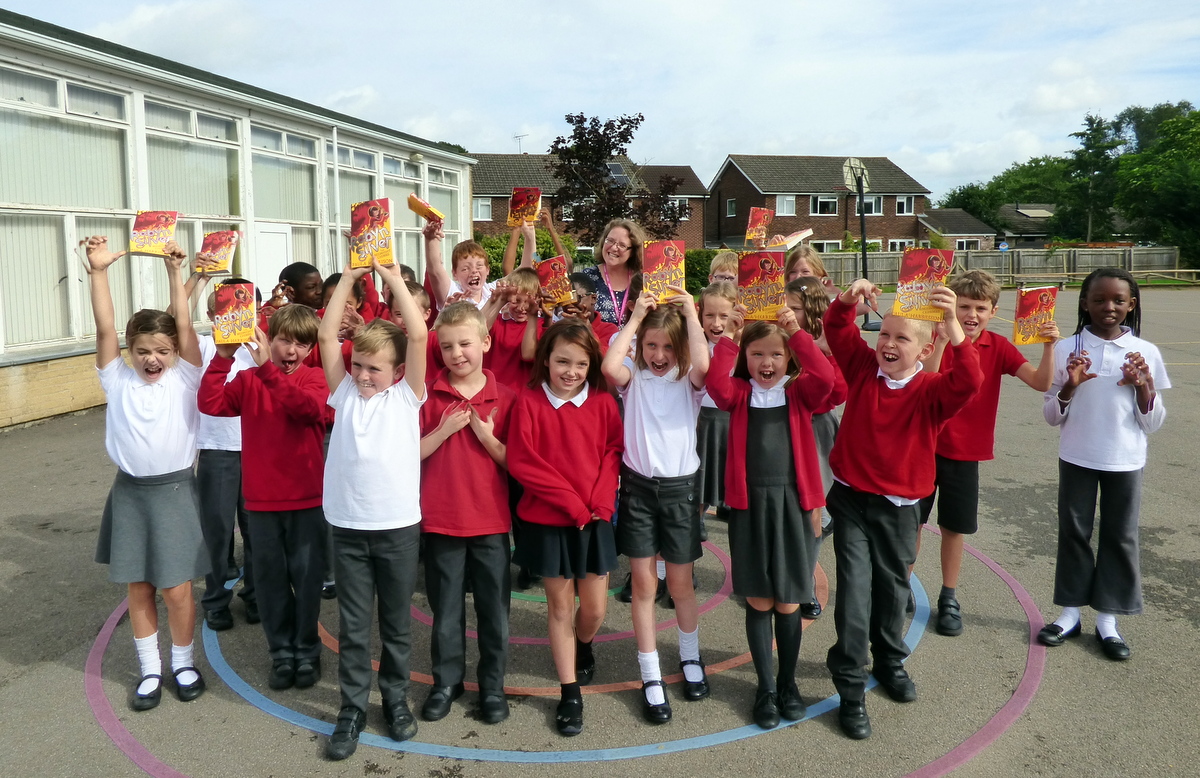
On Friday June 23, we welcomed Elys Dolan to Abingdon, and to Thomas Reade Primary School, where she spent the day talking detective seagulls, glossy steeds and rubbish dragons called Dave with some very enthusiastic - and riveted - children throughout the whole school

Elys had travelled over from Cambridge (on an epic UK tour which saw her in Newcastle and Brighton in the same week).


On her website her interests were declared as 'growing cacti, collecting pocket watches and eating fondant fancies' but it's obvious that what she loves more than anything is to draw.

During each session, the children called out characters to draw, and were enthralled as she brought their suggestions to life on paper in front of them. We had robber squid, a knight with cactus armour - and another knight riding a snow leopard.


Her latest book is called 'Knighthood for Beginners', and is all about Dave, a truly terrible dragon. (That's 'terrible' as in 'rubbish').


Dave is hopeless at dragony things, so when he finds a book called Knighthood for Beginners he decides to learn how to be a knight instead. Dave sets out on a quest with his trusty steed, Albrecht the goat (who scores highly on the 'glossy' stakes), to be brave, chivalrous, and knightly, even up against Sir Gnasty, who scoffs at the idea of a very small, strangely green knight.

Duels are fought, quests are begun...and some fetching knitwear is created...

Here is one of the groups learning to draw 'Steven Seagull', the maverick gull and ex-cop called back to the force to crack a particularly perplexing beach mystery.


This was also the first school event with new owner Sarah Dennis is attendance. It was a lovely event to mark the transition!


Whilst we knew that Elys works predominantly with ink, newfangled digital technology and coloured pencils (of which she is the proud owner of 178) we didn't know much else. Cue five questions to discover more...


1.    What are you working on at the moment?

I'm currently working on a sequel to 'Knighthood for Beginners'. It's another adventure with Dave and Albrecht, onyl this time involving magic and titled 'Wizarding for Beginners'. Cue lots of talking animals and bears. I'm also doing a picture book, similar to 'Mr Bunny's Chocolate Factory' only involving Santa and his workshop. I'm also working on something else - but I can't tell you 'cos it's a secret!

2.    What is the best writing (or drawing) tip you’ve ever been given?

I can give you a tip for drawing: draw things from life. Even if the final picture you end up with isn't realistic, it teaches you to draw what you are seeing, and teaches you to really look at things and observe. And sometimes the details you see end up being what you put into the stories.

3.    What’s the best thing and the worst thing about being a children’s writer?

The best is definitely that writing for children gives you a licence to write about anything, be as silly as you like. The sheer amount of pants in stories might be something frowned upon if writing for adults! The worst is colouring the spreads. For a picture book, at about 3, things are fine but by the time you get to spread twelve or thirteen you are thinking "why is this taking so long?!"


4.    Do you have a writer’s survival kit, eg a place, thing or snack essential before you can start work?

(Thinks) I'm a big fan of snacks, definitely. And you can't go wrong with a cup of tea. But to be honest, give me a paper and pencil and I can pretty much work anywhere.

5.    What was your biggest breakthrough?

When I first started to write picture books, I spent a lot of time putting in elements that I felt should be in a picture book, and the result was a bit of a Frankenstein's Monster. Once I started to have the confidence to develop my own style, and make stuff that I liked and wanted, it turned out that other people liked that as well!

Save Christmas! Matt Haig comes to Abingdon

Given that there are still 44 days to Christmas (that's almost one-eighth of a year!) you might be forgiven for doing a double-take if you'd peeked inside the main hall at Our Lady's Abingdon this afternoon. Christmas jumpers, reindeer antlers, santa hats, and 350 children shouting 'Merry Christmas' at a man standing at the front of the room clutching a microphone, trying desperately to increase the readings on a Christmas 'Barometer of Hope'...

...but it was "snow mistake". On Thursday, Nov 10, children children, teachers, librarians and parent helpers from seven schools welcomed bestselling author Matt Haig to Abingdon, to talk about his book 'The Girl Who Saved Christmas'.


The event was raucous, very Christmassy, and definitely full of hope.

The book is the follow-up to 'A Boy Called Christmas', one of the hits of 2015, and the true story of the boy who would grow up to grant children's wishes around the world. 

The girl in question is Amelia, who seeks out Father Christmas to grant her a wish, but discovers Christmas in danger of being cancelled. Father Christmas has more than impossible wishes to worry about, including upset elves, troublesome trolls and reindeer dropping out of the sky. What can be done?


Matt is a remarkable author, and given that he was in the middle of an awesomely ambitious round-UK tour, full of energy and enthusiasm, as he pitched half the audience against the other in a game of 'Elves v Trolls'.

Matt's Christmas books are illustrated by Chris Mould (no stranger to Abingdon) and even though Chris wasn't able to attend, there was plenty of video of him showing how the illustrations make the book come to life, and how the look and feel of the characters - including a certain Charles Dickens, Queen Victoria and Soot her cat.


Children came from Thomas Reade, Thameside, St Edmunds, Rush Common and Dunmore Primary Schools, and their were pupils from both OLA Juniors and Seniors.

It was a triumph of organisation and hard work by all the schools involved, particularly by the host school, OLA. Thanks to everyone who helped make it happen.


Particularly thanks to OLA librarian Barbara Hickford and her team - every child attending received a special Christmas snowman cookie - and year 7 pupils met the schools on arrival and showed them to their seats.

Matt signed books for children - and also books for the shop, so if you wanted a beautiful signed copy for 44 days time, please do call in. But while Matt signed away, we were able to ask him a few questions about his writing life. Take it away Matt...


Five questions with...Matt Haig's Writing Life

1.    What are you working on at the moment? 

I'm working on two things. Another novel for grown-ups (my first since 'The Humans') about someone who is 400 years old, and I'm about to start on my third 'Christmas' book!

2.    What is the best writing tip you’ve ever been given? 

Write exactly the book you'd want to read. In the early days of my writing career, I guess I had a bit of 'stage fright', and tried to write something I thought other people might want to write.


3.    What’s the best thing and the worst thing about being a children’s writer?

The best thing is that writing for children is very 'freeing' for a writer. Children may have a smaller vocabularly, but they have a much broader, wider imagination, which means you can go anywhere and take them with you. The worst? Being asked your age at school events!

4.    Do you have a writer’s survival kit, eg a place, thing of snack essential before you can start work? 

I can pretty much write anywhere, I'm a 'sit on the sofa with a laptop' kind of guy. Snacks? Well, peanut butter toast provides fuel!

5.    What was your biggest breakthrough?

I think last year (2015), when I published 'Reasons to Stay Alive' and 'A Boy Called Christmas'. After writing for twelve years, last year was definitely the year I felt I'd made it.


(Book blogger and great friend of Mostly Books Annabookbel came along to help - and she wrote her own blog about the event - take a look here!)

A silver tongue and a monster imagination: Paula Harrison, Robyn Silver and The Midnight Chimes

Paula gets the 'rock star' treatment from the children!
A girl who is born on the stroke of midnight and inherits the power to see what no-one else can see – that the world is full of monsters! – is the gripping premise behind Paula Harrison’s latest book, ‘Robyn Silver the Midnight Chimes’.

Paula Harrison visited Dunmore School and Rush Common School in Abingdon to talk about her book and the inspiration behind it. 

Robyn Silver come from a large family and is well-known for being clumsy – but sometimes she isn’t just making a mess sweeping cobwebs, she is actually fighting monsters - but no-one else in her family can see.

When Robyn’s school moves to a big spooky house in the town, Robyn teams up with two other friends from school, Aiden and Nora, also born on the stroke of midnight and realises she is not alone in seeing all sorts of invisible creatures.

A horrifying 'Blug' was just one of many extremely
scary monsters hatched by the children!
They team together to learn fighting skills in secret, but the biggest threat comes not from an invisible monster, but from a monster who has learned to become visible.

Paula said her favourite part of writing the book was dreaming up the monsters and these are brilliantly brought to life by illustrator Renée Kurilla, who also did the compelling bold jacket.

Paula is a good friend of Mostly Books, having visited the shop for the launch of her mega-selling Rescue Princess series, and also involved in the Nosy Crow takeover of the shop back in 2013.

The children at both Abingdon schools enthusiastically joined in creating their own monsters, giving them everything from superpowers to stilettos and inventing mixed-up monsters that would give everyone a scare if they found one hiding under the bed.

The second in the Robyn Silver series is due next year and is perfect for young fantasy readers.

Paula Harrison is best known for the Rescue Princess series for younger readers, as well as the Red Moon Rising series (about an ordinary girl who discovers she has faerie powers) but said she had always wanted to write a book about monsters.

But where in Paula's brain do these monsters come from. We thought we'd better ask a few more questions...

Five questions with...Paula Harrison's Writing Life

1. What are you working on at the moment?
I am working on the next Robyn Silver story, a yet untitled, which will be out in June, and I am working on another series for younger readers which is based on the idea of the Prince and the Pauper where two girls look identical but are from very different backgrounds. They get involved in lots of mysteries.

2. What is the best writing tip you’ve ever been given?
Just do your own thing.

3. What is the best thing and the worst thing about being a children’s writer?
The best thing is you can make anything into a story. The worst thing is too many ideas and too little time.

4. Do you have a writer’s survival kit, eg a place, snack or other essential thing you need before you start work?
I have certain music I play that matches the mood of the characters and I play that beforehand. Then I sit down at 8.30 and work until lunch and then go for a walk and then work until the children return from school. I do tend to stride around the room trying to solve a problem, so it probably does not look very productive.

5. What was your biggest breakthrough?
Having my first rescue princess book picked up off the slush pile by Nosy Crow!

Thank you so much to Paula for travelling to Abingdon, and to both schools for making her so welcome. We've have some fantastic reviews already in the shop from children who've read 'The Midnight Chimes', so if you want to discover more about Paul and her other books, we'd love to see you!


In space no-one can hear you eat chocolate: five questions with Cas Lester

Last Thursday we were delighted to support a visit to Our Lady's Abingdon by children's author Cas Lester, author of the 'Harvey Drew' space stories, 'Nixie the Bad, Bad Fairy' and, most recently, 'Wilfred the (Un)Wise'.

Cas spoke to children from five different schools over three separate sessions throughout the day (itself an achievement!) and explained her journey to becoming an author, and where the ideas for her stories came from.

The children were fascinated to learn Cas started her career as a children's author after an incredibly successful career making children's TV drama for CBBC (including 'The Story of Tracy Beaker').

Her first book, 'Harvey Drew and the Bin Men from Outer Space' is a madcap story about an ordinary school boy who - via a malfunctioning app and an intergalactic communications screw-up - becomes Captain of the Toxic Spew and its stroppy, bickering, pizza-obsessed crew, and a very bad-tempered central computer. Thanks to some remarkably similar experiences managing a school football team (!) Harvey soon starts to take control of this bunch of alien misfits. (Via lots of space-based, rubbish-related, seriously smelly adventures, obv). 

To an audience of over 250 children, Cas explained the very real problem of space junk, bringing with her plenty of objects imagined lost in space and led the children through a raucous quiz on their space knowledge that got them thinking about the very real challenges of waste in space (not to mention trying to do a 'Number 2' in low-earth orbit...yes, exactly)

Cas also spoke about her latest books. In 'Wilfred the (un)Wise', a young magician from the middle ages who gets pitched forward in time. He has to team up with a young girl in the 21st century, who has set her heart on learning cool street magic. Between them can they pull off magic good enough to get Wilf back to his own time?

Troublesome magic is also the theme of Cas's series for younger readers, the first of which is 'Nixie the Bad, Bad Fairy'. Nixie is no ordinary fairy - she's usually slightly grubby, she's often naughty and she has a very mischievous wand. Nixie's adventures are perfect for anyone just learning to read independently.

Cas is a local author and works brilliantly with all sorts of schools, introducing readers to her wonderfully imaginative, chaotic stories.

This was the first time we had a chance to be up close and personal, so Nicki Thornton grabbed the chance to find out all about the hugely talented and hard-working Cas and her writing life...

Five questions with...Cas Lester's Writing Life

1. What are you working on at the moment?

That is quite hard because I’m not supposed to talk about it. It’s a story about a rather different friendship and it is coming out with Piccadilly next August, but it’s a top secret project so I can’t say any more!

2. What is the best writing tip you’ve ever been given?

Don’t give up.

3. What is the best thing and the worst thing about being a children’s writer?

The worst thing about being any sort of writer is you are doing it on your own and you can be quite isolated. But the best thing about being a children’s writer is that you go out and do lots of events and you meet all the lovely children and it’s wonderful to have that great contact with your readership.

4. Do you have a writer’s survival kit, eg a place, snack or other essential thing you need before you start work?

Chocolate, space and a dog. 


For the first time I actually have an office and my dog will come and lie down next to me, which is very settling. Then after a while she will sigh and jump up and go and get my walking boot. I used to be able to work anywhere and can cope with noise except for two things I can’t work through – a child crying and a single fly buzzing.

(Cas also confessed to a drawer full of chocolate - the dangers of being interviewed with your daughter present).

5. What was your biggest breakthrough?

I don’t know if there was a moment when I thought I can now talk about myself as a children’s writer. It wasn’t my first book or even the first time I signed a book because when you first become a published children’s author you feel that you are really a fraud. But I think it might have been when I heard I had only sold one less book than Brian Blessed at the Chipping Norton Literary Festival.

All children can and should read! Barrington Stoke, Anthony McGowan and an evening spent cracking reading

Last Thursday we spent a wonderful day in the company of Mairi Kidd, MD of publisher Barrington Stoke, and Anthony McGowan, award-winning author of many books including 'Brock' and 'Pike'.
Anthony spoke to students from Larkmead School and Thameside School in the afternoon - and in the evening we welcomed teachers and parents to the Larkmead LRC to discover how they can help their children to 'crack' reading.

It was an inspirational evening, one brought alive by Mairi's passion, enthusiasm and courage in the face of the mass of traditionally published children's books which often let down swathes of children by erecting unnecessary barriers to the way words get into a child's brain.


Mairi started off explaining how children read, and then used examples of both the good and the bad in children's books. 

Ultimately it was a plea for diversity in publishing, and to give all children the chance to discover books which allow them enter the world of storytelling off the page - something that has proven benefits in everything from improved maths skills, to reducing stress and improving wellbeing.

Anthony spoke about his route to becoming a writer, reading the opening extract of his novel 'Pike' and talking about the nature of inclusive stories, and the importance of stories to convey 'truth' not necessarily fact.

We made notes on the top issues that would open the door to more children reading for pleasure. This list wasn't exclusive:


1. Books themselves can be the problem. The publishing industry in general does not always think about being inclusive and how making even small changes to how books are presented would actually expanding the pool of readers.

2. Around 7-10% of people are dyslexic and will have physical, neurological reasons why they find reading books difficult.  Small changes, mostly to the way text is traditionally presented on the page would actually remove most of these barriers and make these people able to read books more easily, eg using a font where you can tell the difference between letters (eg a capital I and the letter l looks identical in some fonts).


3. The way children learn to read is often driven by getting them to recognise particular words, or phonics sounds, repeating the same sounds without there being any sense to the sentence, any story worth reading or any point or enjoyment to what is being read. Children can quickly not see the point of reading, particularly children who don’t have books at home or have role models of adults who see reading as enjoyable.


4. Having picture content is viewed as being for young children, yet the internet is full of adults sharing images. If adults find images such good ways of communicating, why do so few books use images?

5. Books are often written in a particular literary style which does not reflect the way people speak. It is more difficult for children to decode meaning. It can take a while to work out what a sentence means. When we speak, we tend to use subject, object and verb in a logical order, but this isn’t always reflected in books.


6. Reading for pleasure should be about magazines, comics, even audio books – anything that opens a door to taking pleasure in the written word or in stories.

7. There seems to be a perception that as teenagers get older, they want longer books. But the teenage years are often where there is most study pressure and competition from other areas of life and many stop reading altogether. Shorter books can help.


8. There is a prejudice against short books – very few ever make it onto prize lists. Yet research has shown that teenage boys would most like to read books of 100 pages or less. So this is the norm, yet almost no books this short are published.

9. We have a thriving publishing sector for young adult fiction, but figures show that 80% of YA of this is bought by adults. So why do we congratulate ourselves on publishing marvellous fiction for teenagers?


10. Everyone can feel daunted by the challenge of reading. One of the barriers to reading for pleasure is fear of failure. It’s a bit like if an adult wants to be recommended a good book to read and is presented with ‘War and Peace’. People’s perceptions of the value of a good book are very different. It is also easy to ‘dumb down’ to reluctant readers and think they will only read books about football or simple topics.

On the Barrington Stoke website, you can read 'Mairi's 10 Laws' which include a suggestion that we think is absolutely fantastic - a National Reading Day. A day to go to work and school as normal, but one where everyone puts their feet up and reads for the whole day. We know several teachers who would love to do this at their schools - so I reckon we should try to make it happen.

Mairi suggests calling it 'Terry Pratchett Day' and we wouldn't disagree with that either...


We have always been very proud of our association with Barrington Stoke, so if you have any concerns about your children reading - whatever their age and ability - please come in and ask our advice.


We always say 'one mountain, many paths' (which we may have cribbed from someone else!) as far as reading goes, and this isn't a one-shot deal to 'solve' your child's reading issues. It's definitely a journey, there may be a few false starts, but we know that there are books out there that can really open the door to reading - and Barrington Stoke titles (written as they are by many of our most well-known children's authors) is a great place to start.

Thanks to Linda Stone at the Larkmead LRC for doing such a fabulous job of hosting the event, and also to Sally Poyton who helped with the author event in the afternoon - and ran the bookstall for us in the evening.

Having an author to ourselves for most of the day was also a bit of a luxury, so we managed to ask Mr McGowan a few questions about his writing life, and any tips he might have had...

Five questions with . . . Anthony McGowan's writing life

1.    What are you working on at the moment?

I'm working on a teenage horror/Sci-fi mash-up called "The Wrath" (working title!) set in the future. It centres on a school in a desolate, barely-functioning town, and specifically in an exclusion unit within the school. When a train accident involving a battlefield chemical agent spills into the schools, it turns out the kids in the unit - by way of a medication they have been taking - are unaffected. I like to think it's horror in the way that Stephen King writes horror, aside from the idea and setting, what drives the story forward is following the individual characters that you invest in. I'm also hoping there will be a 'Battle Royale' feel to it (the Japanese novel some cite as an influence on The Hunger Games).


2.    What is the best writing tip you’ve ever been given?

I wasn't really given any writing tips as such starting out - I just started writing and made loads of mistakes along the way. But the one thing I did do is read a lot, so I guess I passively absorbed a lot of great writing. After that it's just trial and error as you find your own writing style.

3.    What’s the best thing and the worst thing about being a children’s writer?

When you are writing for teens, you are writing for readers who are at the most intense phase of their life - their friends represent the strongest friendships they will ever have, they have enemies that want to do them actual harm. But above all they are incredibly open to ideas, which means they will go with you on whatever direction you want with the story. They are open to challenging - and sometimes upsetting - subject matter in a way that isn't the case once you get into your 20s. I've talked to students who have walked out because of the subject matter in my books, but teens would never do that.

4.    Do you have a writer’s survival kit, eg a place, thing or snack essential before you can start work?

I have a study - the smallest, ugliest room in the house with a window you can't really see out of. And that's where I write, because it's the room with the least distractions. But sometimes I want a place which is a bit more 'active' and I head to the British Library. It's only a half hour bike ride away, but it feels like I'm definitely heading out to work like a proper job (rather than sitting at my desk in my pyjamas!)


5.    What was your biggest breakthrough?

That's a really interesting question (*think hard*). I did a PhD, and that required me to write 100,000 words, and actually *finish* something, so I knew I was capable of writing a physical book. I then found myself working in a pretty dull job, and one day I had an idea for a story, and I started writing it down, and the words just flowed out. So I knew I could *write* (getting the words out and down) but I think - creatively - the breakthrough was when I realised that what I was writing was funny, and then I showed it to someone, and they thought it was funny. If you can use humour, you know you can engage the reader. That book went on to be 'Hellbent' my first novel.

(Much more about Anthony McGowan on his website here)

The Enid Blyton of Murder! Tanya Landman at the Abingdon Joint Author Event

Tanya Landman started off receiving some fantastic career's advice at her school - nurturing, inspirational - which can be summed up as 'if you don't know what you want to do in life, you're doomed!". Luckily for her - and us - she wasn't too freaked out by this mentoring-from-hell experience, and after working in a bookshop, Arts Centre, Bristol Zoo and travelling performer - she became an author.

Her breakthrough book was 'Apache' - shortlisted for the 2008 Carnegie Medal - and the seed of an idea from that book grew, several years later, into 'Buffalo Soldier' which won last year's Carnegie Medal and, quite rightly, elevated Tanya to the Pantheon of contemporary children's authors. It was a huge coup to get her to come to Abingdon, and groups from eight schools in Abingdon came to visit over three sessions.

Tanya is funny, wise and inspirational - and (with the help of a large globe) gave the children a crash course in geo-politics and the history of colonialism in North American. She shared her own journey of understanding of American history, from facts gleaned from the pages of 'Gone with the Wind' and watching Westerns, to the stories of remarkable native americans - and the freed slaves who fought against these brave warriors in the aftermath of the American Civil War.

In her own words she felt that these hidden stories of the American Deep South were "a piece of the jigsaw dropped down the back of the sofa of history" and felt compelled to tell that story.

Along the way, we discovered the real reason Tanya started writing murder mysteries for kids (no spoilers here, but we will say that this story is worth asking Tanya to come to your school all on its own), the inspiration behind the children - and dog - in her Sam Swann books, and why you wouldn't want to be up against her at an award's ceremony...

Tanya enjoys writing about murder (possibly a little too much, according to her publisher). In ‘Mondays are Murder’, her child sleuth Poppy Fields goes on an activity holiday to a remote Scottish island. She is looking forward to a week of climbing, hill-walking and horse riding. But things take a bad turn when their instructor has what appears to be a fatal abseiling accident. When Poppy discovers that his rope was cut, and more of the instructors start to have "accidents", she and best friend Graham suspect foul play and decide to investigate...
Tanya's crash-course in colonialism and
'places not to go if you are
a sailor in the 15th century'...

There are now ten books in the series, so the description of her as the 'Enid Blyton of Murder' may not be too far-fetched...

Tanya also talked about her latest book ‘Hell and High Water’. This is a fantastic book for teens, a thrilling adventure story set against the backdrop of smuggling and conspiracy, and based on research Landman did around the notorious villain Thomas Benson, owner of Lundy Island, corrupt merchant and MP for Barnstaple in the 18th century.

When a body washes up on a beach, Caleb Chappell finds himself involved in a dastardly plot: a plot that places him and his family in mortal danger. With his father falsely accused, it is up to Caleb to save him.

Drawing parallels with modern political corruption, this tells a gripping tale with plot twists galore and strong, believable characters that stay in the memory.

In between sessions, we asked Tanya to tell us a little bit about her writing life...

Five Questions with...Tanya Landman's Writing Life

1.    What are you working on at the moment?
Not telling you!

2.    What is the best writing tip you’ve ever been given?
Daydream! Get it all started in your head first, before putting pen to paper. Writing it out is just technique, but you need to get the idea ready in your head. It needs to get you excited – it’s why I didn’t want to tell you about what I’m working on at the moment actually, because I feel if you talk about it too soon when it’s still in your head, you ‘deflate the cake’!

3.    What’s the best thing and the worst thing about being a children’s writer?
Getting out to schools, book events, or the Carnegie Shadowing. It’s incredible how much energy and enthusiasm you encounter. The worst thing? Every author has days when, what you are writing, isn’t just the worst thing you’ve ever written, but the worst rubbish any author has ever written, ever. You have to write through it of course – but those days are really tough.

4.    Do you have a writer’s survival kit, eg a place, thing, or snack essential before you can start work?
Cup of tea!

5.    What was your biggest breakthrough?
With Apache, it was really the moment when an idea was triggered in my head, and my fingers started twitching, and I had an image in my head. This had never really happened before, and was very different to things I had written before.


The Abingdon Joint Author Event has seen some fantastic authors over the years - Caroline LawrenceAlan GibbonsJulia Golding and Marcus Sedgwick - and yesterday's event with Tanya was a splendid addition to this tradition.

As always there is an incredible amount of hard work behind the scenes from the Abingdon school librarians and teachers who accompanied children to and from the event - we honoured to be asked to get involved. We know just how much time, effort and planning goes in to taking children off timetable - but hopefully listening to an inspiring, award-winning author is worth all the effort!

Thanks also to the awesome help from Jo and Sally, and finally, thanks to Tanya for being such an amazingly inspiring speaker, writer (and incidentally passing the Mostly Books "authors-you'd-most-want-to-go-down-the-pub-with' test!)

To discover more about Tanya, come into Mostly Books to discover what she has written - or visit her website to learn more about her writing.