Showing posts with label schools. Show all posts

It takes a village to raise literacy

We get approached very often by schools who wish to partner with us in promoting literacy and celebrating books and reading. By far the most popular services are around matching authors visiting our area to go into schools as part of a school author visit.

But demand from schools always outweighs our ability to match an author to a school at an appropriate time. And we only have a limited capacity to go out to schools and keep the shop running as well.

So over the Christmas break we got thinking. After all, the ReadOnGetOn initiative urges everyone to get involved in raising literacy, and we feel very passionately that independent bookshops - with their community connections and route to discovering new authors and ideas - have a small but critical part of the jigsaw to reverse the decline in literacy in the UK.

Can we work together better with schools, teachers, parents, librarians and authors to do our part in fostering a love of reading? And can we do it in a way that allows us stay in business on the High Street?

We're not sure, but we suspect the answer is yes. So we've put up a page on the website with a few ideas, starting with the fabulous WOBOD, the World Book Day Award in which your school could win a library-changing sum of money to spend on books...go take a look.

You see, if old Victor was around today, perhaps the thing that he would find so astounding is the speed at which ideas can propagate around the world: a well-timed blog, a couple of hundred retweets, perhaps the odd pic on Instagram to add a visual stimulus. Remarkable. But the basic mechanism he would recognise: using words to neatly formulate an idea, and have that idea race off into the world and start transforming it.


That's the essence of literacy: the use of words. Reading them, writing them, understanding them. Stringing them together to write a story, or make a speech. Or to ask for a payrise, tell a good joke to your mates down the pub, talk through the loss of a loved on, decide on who to vote for. And whilst a picture might be worth a thousand words, a picture with a few words on it is even more powerful.

And a thousand words is as good as a picture. Which means words trump imagery because they take us to places we can't go, like the past and the future. The pen is mightier than the sword and the camera, neat huh?

But words still need time to percolate in the brain. Time and space need to be created away from the overwhelming buzz and chatter of the modern world to allow those words to soak in, top up the reservoirs and be marshaled in the brain for use in the wider world. That's why we're championing family reading.

It takes a village to raise a child. And we reckon it takes a 'village mentality' to raise literacy. We hope you can take part in this, and the first step might be into your local independent bookshop?

Finding, Binding or Minding? Five questions with Archie Greene author DD Everest

One of our favourite children's books of the year has been Archie Greene and the Magician's Secret, a thrilling and imaginative fantasy book set in the mysterious world of ancient books, old magic and with an Oxford twist. It marks the arrival of an extremely talented author, DD Everest, so when we were offered the chance by publisher Faber to take him to some schools in Abingdon, we jumped at the chance.

The first D stands for Des - so that's what the children were asked to call him. First stop was Our Lady's Abingdon, and he introduced himself by telling the children about his own children, and the children's football team he coaches...

...before getting into the story of Archie, a young orphan who - seemingly - accidentally gets taken on as a magical apprentice to the mysterious 'Old Zeb' in the bowels of an ancient Oxford bookshop...


Archie received a old, musty parcel containing a magical book - and a similar looking parcel turned up during the talk. We all had to guess about what might be inside.

In the magical world that Archie discovers, there are different routes available to apprentices, depending on whether children have the sharp eyes of a hawk ('Finders'), the wisdom of an owl ('Minders') or the quick hands of a monkey ('Binders'). When asked, there was a good spread of votes for all three amongst the audience, so that bodes well for any apprentices in the audience.


One of the great things about having a break between the two schools, was that we were able to bring Des to the shop and chat to him a bit about what makes him tick as an author. One of the interesting things was to learn more about his passion for Tolkien, and how all fantasy authors - to a greater or lesser extent - are writing in his shadow. What great fantasy authors do, however, is to take the furniture that is already in the room (so to speak) and make it their own.

Des also compared the world of journalism and writing books. With journalism, you write to a deadline, and that's a great skill to have. But when you have a publisher, and an editor, they remind you that what you are writing is going to have a longevity to it that most journalism doesn't have - they fire questions, and challenge about all aspects of the book, until it becomes bullet-proof. It's a very different process - and for one for which he is really grateful for having a publisher behind him.

The afternoon saw us at St Edmunds Primary School, where an enthusiastic group bombarded Des with questions about the characters and his writing...  
Having seen many different authors talk to children over the years, one of the things that impressed us particularly about Des was his skill in conjuring up the world of Archie Greene in the minds of the children in the audience. The children seemed to relish the opportunity to become apprentices themselves, and some of the terms in the book - such as nasty magicians called 'Greeders' conjured up just the right atmosphere or excitement and menace for the age it's aimed at.

The result was a whole host of very imaginative questions. On being told about the dangers of a 'Drawing' book (which don't sound very scary, but actually 'draw' you in to a book from which you may not escape) the children wanted to know who could pull you out, and whether you were yourself inside the book - or took on the part of one of the characters. And would you actually *know* that you were inside a book? Des wasn't given too much away - the fate of Archie in the story turns on some of the answers!

Des ended with some writing tips - and a poll on whether children liked the UK or US cover best - what do you think?
 

With 'Archie Greene and the Magician's Secret' already shortlisted for an award or two, we think DD Everest is an author destined for very big things, so we were keen to find out a bit more about him... 

Five questions with . . . DD Everest's Writing Life

1.    What are you working on at the moment?

I'm currently working on the second Archie Greene book ‘Archie Green and the Alchemist’s Curse’. I’ve done the first draft with edits, so now just waiting for ‘feedback’ from my editor (Alice Swan) - it's a nerve-wracking time!

2.    What is the best writing tip you’ve ever been given?

(Thinks for a moment) I'm not sure whether I should say this, because it sounds a bit simplistic but...writer’s write. They don’t talk about it, or sit around talking to other writers, they just get on and write. Ideas build and grow inside of you. If you talk to others about an idea, once you've shared that idea, you sort of burst your own balloon. Writing is lonely, it can be demoralising, but that’s what it is. You shouldn’t be intimidated by the blank piece of paper, you have to push through it.


3.    What’s the best thing and the worst thing about being a children’s writer?

The best thing is that children have very fertile, rich imaginations. They give you lots of licence to be imaginative – the canvas you are working on is wide and very open.

But the flip side of this is that fertile imagination is a double-edged sword. That imagination tens to question everything, and allows them to often get ahead of the plot, and if you have holes they will find them in a way that adults don’t – often adults are happier to go along with the story. Kids can also be brutally honest and blunt about what you write.

4.    Do you have a writer’s survival kit, eg a place, thing or snack essential before you can start work?

I think a writing ‘space’ is very important, but because I’ve been a journalist, I can write anywhere. When you are a journalist you don’t have the luxury of writer’s block – you are completely deadline-driven. However, I do like to declutter my desk: I’ve even been known to sweep everything off the desk, or hide things. Your desk is like a mirror of inside your head, or a metaphor for your writing canvas. I did used to have a ‘lucky’ desk years ago – but that went to the tip!

5.    What was your biggest breakthrough?

I think there are two moment that I can remember, one creatively and one with becoming a bona fide author. I’d written the start of a story and my own kids were asking for more chapters, and that was a good sign. But for me the main breakthrough was sitting in the offices of Faber and Faber, and here were these ‘proper’ publishing people talking about my book and characters as though they were real people. It was a great moment – and I thought: whatever happens from here, I can’t imagine it feeling better than this.

Abduction, Abuse, Brutality, Hope: The Abingdon Carnegie Forum 2014

Of the four words in the title, can you spot the odd one out?


The annual Abingdon Carnegie Forum is one of the highlights of our year - something we have been involved in for six years now, ever since our first forum back in 2008. The forum sees Carnegie Shadowing Groups from six school in Abingdon come together, with a day of workshops and frenetic activity to celebrate the culmination of this year's Carnegie award. As well as a vote amongst students as to their favourite book, schools are mixed up into different groups, and they are given one of the shortlisted titles for which they have to put on a 4-minute performance in front of all the other students.

Terrifying huh?

The aim is to 'pitch' the book to the audience, using the performance to convince us all that their book deserves to win. It works brilliantly, even though for some of the students they are having to pitch a book that they may not have necessarily liked.

This year had a very different feel to it for several reasons. Firstly, I was chair of judges this year for the first time, which meant I had to concentrate extra hard to make sure I didn't screw up in announcing the winners at the end of the day (I have 'previous' in this area).

Whilst I missed the opportunity to take a Jim-Al-Khalili-style audience selfie, I did perhaps the next best thing...

Secondly, this is the first forum I have been involved in where the winner was known before the actual event. The Abingdon forum is notorious for never voting for the winner, so would this be different this year?

Finally, it cannot have escaped anyone's notice that the shortlist this year has been, well, a tad controversial. Four of the books deal with abduction and abuse in some form and certainly in the shop, we have had more conversations with (and concerned emails from) parents this year concerned about the content of the books that children involved in the Shadowing were being asked to read.

Stand out titles in this regard were the brutal and bleak 'The Bunker Diary' by Kevin Brooks (abduction, torture, murder), 'Blood Family' by Anne Fine (alcoholism and drug-abuse), 'All The Truth That's In Me' by Julie Berry (abduction, mutilation) and 'The Child's Elephant' (elephant poaching, child conscripts).

A jolly old roster of themes to get stuck into. And it was notable - and we judges made the point in our summing up - that several children had had difficulty sticking with the books. Phrases like 'it will shock and disturb you no end' (All The Truth That's In Me), 'his mother, beaten and crazy' (Blood Family) and 'pointless and crushing' (Bunker Diary) were accompanied by a general sense of unease and a surprising amount of guidance in terms of how old readers should be to deal with the violence.

(For an excellent collection of reviews on each of the shortlisted titles, head on over to Space on the Bookshelf, which has been reviewing each title and the competition in genera, for the last few weeks)

And yet, and yet...

"I think [it is] is a gripping, skilfully written novel. I felt that every word that had been printed was true and spoken directly to me, as if there was no book, just Eddie and the other characters standing in front of me talking" (Blood Family)

"...an amazing, well-written, unforgettable story that kept me reading almost non-stop from three o'clock in the afternoon until I finished at one o'clock in the morning" (Bunker Diary)

"This book proves the true significance of friendship" (The Child's Elephant)

The 'Rooftoppers' group and
infamous 'Chelsea Buns'!
Talking to some of the children, may had mixed emotions about books that hadn't exactly 'enjoyed' but felt were 'amazing'. In that regard, some of these young readers had had wonderful literary experiences, which many adult readers may never have had.

Many of the reviews described reading late into the night to finish what were gripping books.

The unprecedented outpouring of hand-wringing and condemnation of The Bunker Diary in particular (notably being described as 'vile and dangerous' by Lorna Bradbury in The Telegraph) has been met by a robust defence by the CILIP judges and from his publisher Puffin. Children's book critic Amanda Craig, hugely respected throughout the publishing world, has tried to provide some context by looking at the history of the Carnegie in this article in The Independent. However, she refused to review The Bunker Diary on publication because it was so bleak.

This definitely feels like battle lines being drawn up - and booksellers are increasingly finding themselves on the front line of this battle, having to listen to the concerns and alarm of parents, and - increasingly- school librarians (under pressure IMHO to take the side of CILIP and defend books they feel uneasy about).


The reality is that many of the children actually doing the Shadowing tend to be 11-13, because the older children get, the less time they have to read generally, and the more focused they tend to be on studying for exams (we know this anecdotally from the shop: nothing kills reading for pleasure more effectively than exam pressure). Several of these books are for teens - indeed Kevin Brooks' own defence is that he's written for teens, and 'they can handle it'. But a significant number of the readers aren't teens. And even when age guidance is given by school librarian, those confident bright readers who are up for a challenge don't want to be left out. Remember peer pressure at school? Difficult to resist.

CILIP can't pretend that this isn't an issue, and they have a responsibility not to put children, parents and librarians in positions where children are under pressure to read what they can't handle.

Recreating a scene outdoors
ahead of the performance
But there is also the commercial pressure from publishers to 'up the ante' in terms of content to tap into the current sweet spot of publishing ('Young Adult'). We recently had a big argument with one of our reps, who age-guided a particular book as 12+, and then (sotto voce) hinted that it was really 'at the upper end' of that age range [sic]. Given the brutal content of the book, we decided to formally complain about the age guidance to the publisher (who, to be fair to them, responded sympathetically and are looking into changing this).

Right, time to dismantle the soapbox. I think the most considered and sensible comment on this comes from the extremely wise and sensible Frank Cottrell-Boyce who has said "The Carnegie was instituted as a prize for children's fiction. Brooks is a YA writer. YA fiction is extremely lucrative for publishers...Could not some of the publishers who have done so well out of the category stump up for a YA prize instead of predating on one of the few places where children's books aimed at children can still get some attention?"

(Well said. And splitting the prize would neatly address the 'young shadowers' issue. Will be interesting to see how CILIP respond)

An Abingdon Carnegie Forum tradition - cake!
The vote was taken at the end, and - perhaps unsurprisingly - for the first time, the popular vote matched the actual vote, with The Bunker Diary being the winner. Kevin Brooks deserves a lot of credit for writing such a superb book with great skill - it has had a great, and mostly positive, impact on many of the children who read it.

As always, thanks to the tireless efforts of the Abingdon Schools - particularly the librarians - for creating such a fantastic day, The judges read through an extremely high-quality shortlist of book reviews. What is always impressive is the quality of the reviews, across all the schools, and the language, passion and flair of what is a skill in its own right.

And that odd word out? Hope. Left at the bottom of Pandora's Box, and something we feel all children's books, no matter how dark, should have a little of...

(Update 4/7/14 - the splendid Gerald Dickens, great-great-grandson of Charles Dickens - was the guest of honour, and you can read his blog of the day here. And Griselda Heppel, author of Ante's Inferno, has written a rather excellent, succinct piece on YA fiction, the Carnegie Medal, and how we got here, on her blog).

"You only enter a dark room if you think you can light the way out": Alan Gibbons at the Abingdon Joint Schools Author Event 2013

Last year it was The 2 Steves. Before that it was Julia Golding and in 2010 Marcus Sedgwick. This year over 400 children from five Abingdon secondary schools came together to welcome Alan Gibbons for the annual Abingdon Joint Schools Author Event - easily one of the highlights of our school's event year.

Officially, Alan Gibbons is 'a Blue Peter Award-Winning Children's Author'. Unofficially he's a hyperactive bundle of subversive ideas and creative energy who by turns gripped and entertained his audience over two sessions last Thursday. Those lucky enough to be on the end of his fizzing, rapid-fire romp through his writing life didn't just discover about his books - they got tips on a whole host of important life lessons, ranging from what to read and why, to the correct application of foundation, and 'where to put your nose when kissing'.
Alan is the author of over fifty books, and he has been unafraid to tackle often dark and disturbing themes which at times makes his writing challenging - but he's such a natural and optimistic storyteller that readers inevitably emerge on the other side of his books, changed - but full of hope.


Alan was talking about his latest title - 'An Act of Love' - but he also took students through other books he has written. He estimates he does nearly 200 school events a year, not just in the UK, but around the world.

He won the Blue Peter Award in 2000, and if you had to draw up a more intimidating list of authors to have been against, then I challenge you to pick a line-up better than Jacqueline Wilson, JK Rowling, Michael Morpurgo and David Almond (a sort of 'Real Madrid' of children's authors if you like).

As an ex-teacher (and one with some serious firebrand pedigree – he once jumped up on stage, grabbed the microphone from Keith Joseph and was ‘helped’ offstage by security) he’s both vociferous and uncompromising when it comes to children and learning. Believing that children shouldn't do comprehension ("children should read 'Of Mice and Men' for example, then write what they think as a result, with no rules...and that’s it") he nevertheless had a great tip for any budding writer to improve their writing.
With a book that you like, where you respect and admire the author, take a chapter that you particularly liked and read it through again very carefully. Try to tease out those elements which work well. Learn from the masters...

His own recommendations of classic children's literature included 'Emil and the Detectives', 'Treasure Island', 'Danny, The Champion of the World' to 'To Kill a Mockingbird' and 'Jane Eyre'.

There were some great questions from the audience, including "How old were you when you first started writing?" (37), "How many books have you written?" (53) and "If you had a hamster, what would it be called?" (Darth). My personal favourite – which character in literature would you have wanted to have been. The answer: Rochester from Jane Eyre ("gets to marry Jane Eyre") but not Heathcliff ("far too destructive").

He signed books after both sessions, and we naturally tried to pin him down with five questions about his writing life...
Five questions with...Alan Gibbons' Writing Life

1.    What are you working on at the moment? 

My next book is called 'Raining Fire', it's now written and is going to be published on March 7th. It's about gun crime and gangs in the North of England. The book I'm currently working on is 'Hate Crime' which is a novelisation of the real-life murder of Sophie Lancaster, killed for wearing alternative clothing. However, I'm already planning my next novel, and (although my publisher doesn't know it yet!) it's an alien invasion story which is an allegory of the war in Iraq. So I'm keeping busy, writing lots of stuff really.

2.    What is the best writing tip you’ve ever been given?

Do it a lot! You learn to write by writing, and also making mistakes.

3.    What’s the best thing and the worst thing about being a children’s writer?

The best thing about writing for children is that most kids are charming, and therefore school visits are the absolute highlight of my writing life. The worst thing is that there are not that many kids around, so you don't get as many sales. But that's not a problem, I love what I do and I'm totally committed to children's education and literacy.

4.    Do you have a writer’s survival kit, eg a place, thing of snack essential before you can start work?

No, not really. I write anywhere, I'm a complete writing traveller. Give me a laptop, I'll write anywhere, hotel rooms, on the stairs...

5.    What was your biggest breakthrough?


'Shadow of the Minotaur' which won the Blue Peter Book of the Year. Winning that award, when I was up against Michael Morpurgo, JK Rowling, Jacqueline Wilson and David Almond it was (laughs)...I still don't know quite how it happened. That book went on to sell 100,000 copies, more than all my other books put together at the time...


From elephants to evil headmasters: Gillian Cross at Our Lady's Abingdon

For an author who said she'd never write about animals, Gillian Cross’s research has taken her not only to meet a friendly elephant, but to encounter a not-so-friendly pack of wolves.

But you have to be prepared to be adaptable if you want to be a writer and sometimes ideas can just take hold, the author told an audience of Abingdon school children at Our Lady's Abingdon on Thursday September 27 as part of the school’s week-long reading festival.

Her book ‘The Great Elephant Chase’ is an historical adventure when children run away and embark on an epic journey across America – trying to hide an elephant.

She had the idea for a long while but kept rejecting it as she didn’t think writing about animals was something she could do, but the idea grew and then she had to discover not only how to write about an elephant, but to write about a country she’d never visited and what it was like over a hundred years ago.

For her research she didn’t make a single trip to the USA, but relied on historical societies sending her photographs and details to work from.

But when it came to writing about the elephant she decided she really wanted to be able to see one up close and to touch it to be able describe what it looked and felt like. So she ended up in London Zoo.

‘My favourite thing about writing is when I might have started writing, and I think about the book and then suddenly it will take off and I think 'I can do this and that' and the whole thing slots together like a jigsaw puzzle. I always also learn something important when I write and that’s how you get to understand people when you are writing about them.’

Even the Demon Headmaster series, for which she is probably best known, came from an original idea from her daughter, who then badgered her to write the book. ‘I hate people telling me what to write, but she went on and on about it,’ said Gillian.

Her daughter wanted her to write about an evil headmaster, but at first Gillian couldn’t see how it could work. It was only when Gillian had the idea of him hypnotising his pupils that the idea really took hold.

The books, which are also about the rebellion by the few children he can’t hypnotise, was made into a television series and was also published in many different countries.

She showed the children how the cover has evolved since the book was first printed – with more than ten different editions, each having a different cover look and got them to vote on their favourites.


Her favourite book of the 51 she has written is ‘Where I Belong’ set partly in Somalia and partly in London. Again, it is an adventure story, with a backdrop of the fashion industry and a Somali girl who is spotted to be a model.

With such an interesting approach and experience of writing her novels, we were keen to ask Gillian a few question - and she obliged!

Five Questions With...Gillian Cross's Writing Life


1.    What are you working on at the moment?
I am between books. ‘After Tomorrow’ comes out next year which is about a time of economic collapse and English families have to flee to France as refugees. It’s an adventure story, but it came about because I started wondering what it would be like if people in this country had to go to another country as refugees.

2.    What’s the best writing tip you’ve ever been given?
Do not worry if it sounds silly, you can always go back and re-write, but when you first write something down it very often sounds stupid.

3.    What’s the best thing and the worst thing about being a children’s writer?
The best thing about being a children’s writer is you are free to write what you want to write and not get tied to a particular thing. The worst thing is that many people think if you write for children you must write picture books, but I actually don’t think I could ever write a picture book.

4.    Do you have a writer’s survival kit, eg a place, thing or snack essential before you can start work?
I do go back to long hand if I get stuck – that and go back to where I thought the story was last working. That and drinking a lot of coffee.

5.    What was your biggest breakthrough
Writing ‘Wolf’ because I really challenged myself and it was an experiment, but it made me feel I could really try different ways of telling stories.

Being Billy in Carterton - the launch of the CartertonCC Book Club with Phil Earle

This evening we were very privileged to be invited to the launch of a fantastic (and marvelously ambitious) new book club based at Carterton Community College, in the company of the author selected as its first read, the mighty Phil Earle (author of Being Billy).
Calling it a 'book club' doesn't really do the scope and ambition of this project justice. The idea of its founder Chris Davies, an English Teacher at the school, is to use the school's brand new library to act as a community hub, encouraging as many people to borrow, read and discuss the current book as possible. Carterton has some unique challenges - and opportunities - as a town and books (particularly the right kind of books) can bring people together from all walks of life.

(There is a brilliant write-up and interview with Chris in the Oxford Mail which explains a bit more about the background).

Author Phil Earle is an inspired choice for the first book, and he spent an intense day talking to students before explaining at the launch about his life as a writer, and his unusual route to becoming one. Phil was a reluctant reader in his childhood, preferring comics and graphic novels, and even now no-one buys him a book because he's "dead picky...they know I probably won't read it".


Appropriately for a town closely involved with military repatriations from nearby Brize Norton, Phil's next book 'Heroics' focuses on the story of two brothers, one of whom is posted to Afghanistan, and Phil did a reading from the book, due to be published in April of next year.


The club is an inspired undertaking, and Mostly Books is extremely proud to be involved. We will be racking our collective brains over the coming weeks and months to suggest books and possibly authors who might be able to get involved. In the meantime, we would definitely urge people to get involved - whether they live in Carterton or not - to read the book, and post comments to the CartertonCC Book Club Twitter feed here. The next club meets on 24 October at the library...

Of course, we took the opportunity to ask Phil a few questions about his writing life...and some surprising and very different answers he gave too...


Five Questions with...Phil Earle's Writing Life

1.    What are you working on at the moment?
I'm currently working on 'Heroic' due out in April. It's a story of two brothers, inspired partly by the repatriations at Wootton Bassett, but also partly from SE Hinton's 'The Outsiders'. I guess at its heart is the theme of brotherhood, 'what wouldn't you do for your brother?'.

2.    What is the best writing tip you’ve ever been given?

Love your main character, but be horrible to them. It sounds cruel, but the more mean and nasty you are, the more your reader will love them!

3.    What’s the best thing and the worst thing about being a children’s writer?

The absolutely best thing is school events. You get to meet children, speak to them - I love doing them. You spend months and months writing the book by yourself, it's great to finally get a response.

The worst (Phil thinks hard at this point). I think it's if the opposite happens, that people aren't reading it, if you know the book isn't reaching the audience it should.

4.    Do you have a writer’s survival kit, eg a place, thing of snack essential before you can start work?

The Bus. In fact, a bus - the X68. I do most of my writing on the bus, at home it just doesn't seem to flow the same way!

5.    What was your biggest breakthrough?

It was the moment I got Billy's voice. Four chapters or so in, without a plan. To me that's the special joy of writing, I'm not a planner. Well, I write a synopsis at the beginning, which I then don't look at again or destroy. But no, once I knew that Billy's story was going to be told, and turn out the way I wanted it - that was my breakthrough.

3 4 Friday: Back to School!

Our focus this week is unsurprisingly ‘back to school’. It is, after all, that time of year. So here are three school-related items for your Friday reading pleasure - and a giveaway at the bottom!

Firstly, and as we get asked a lot about our services for schools, we've put together a special page called "What Mostly Books can do for your school" that details all our main services.


Secondly, even if you don't have a budget for books at the moment, one of our most popular services is a book fair. This is the perfect time of year for us to come into your school to showcase all the year’s best books to keep children reading – and to raise funds for your school at the same time. More details on the link above - or email us for more details.


And finally (talking of schools) brings us to our first event of the Autumn, an evening with legendary speaker, chef and all-round Englishwoman Clarissa Dickson Wright. As someone who is a big supporter of independent bookshops, a first-class writer and even an ex-bookseller (amongst many other things) Clarissa has a reputation for being an extremely entertaining and memorable speaker – and we have been working for about three years to lure her to Abingdon.

We are hosting the event at Our Lady’s School, Abingdon – forming part of their annual book week – and tickets are now on sale in the shop. The event takes place on Wed Sep 26 at 7.30pm. Tickets cost £7 and includes a glass of wine (or soft drink) with £5 redeemable against a purchase of her latest book “Clarissa’s England” – a delightful romp through the country of her birth.

We have a pair of tickets up for grabs in our prize draw – to enter, you need to visit our event page and email us the answer to the following question: 


"Lincolnshire has the world’s second largest coriander crop, but which country has the first?"


All answers received by 5pm next Thursday (Sep 13) goes into the draw to win (and if you have already purchased tickets, as many of you have, don’t worry – you can still enter and we’ll refund you what you paid.).


Good luck!

Unrest by Michelle Harrison - unsettling, unnerving...and coming to Abingdon


When I was a teenager I loved ghost stories, and the scarier the better. As well as lots of 'true life' ghost books (Reader's Digest Book of the Unknown is one that springs to mind) I devoured every collection of ghost stories I could get my hands on, and this rich diet of the undead brought me to the attention of my English teacher, who - after a harmless walk around the school ended up with me describing trees as 'twisted victims of Satan' - wrote 'See Me' in big red pen, and at that point we both decided to 'widen' my range of reading...

Anyway - a chilling, well-written ghost story for teens is always welcome at Mostly Books, and Unrest by Michelle Harrison is simply superb. We know Michelle very well for her '13 Treasures' series of books, which are written for slightly younger readers. There are plenty of scares and shocks in these 'dark fairy' books which served as a kind of reboot of the fairy genre - but in Unrest, Michelle has gone off into much darker territory, entirely appropriate for an older audience - one that would have grown up on Michelle's twisted fairies...

Unrest is the story of Elliot, a seventeen-year-old who feels and sees strange things when he falls asleep. His doctor tells him it is sleep paralysis and hallucinations as a result of an accident but Elliot thinks he is leaving his body when he sleeps - and also seeing a ghost. In pursuit of the truth, Elliot gets a job at the (supposedly) haunted museum, where he meets not only the enigmatic Ophelia, but also someone (or something) far more sinister. Elliot begins to suspect it is the ghost of a boy who died 100 years before, and as events take an increasing horrifying turn, there is a race to discover the truth.

Julia at Mostly Books read this as soon as the proof came in, in a single sitting. She said "this is a genuinely chilling and totally gripping ghost story, and - with Elliot's nightitime experiences and visions - it shares elements of, say, The Sixth Sense in terms of the atmosphere it creates. There's a particularly scary night-time sleepwalking scene that is *definitely* not for the faint-hearted, the book grips (and shocks) from the start, and doesn't really let you you go to the gruesome (and very unexpected) twist at the end. I loved it".

So - how chuffed are we that we are welcoming Michelle to Abingdon next Friday (May 4) and taking her into two Abingdon schools? First up is a joint event with Larkmead School and St Helen & St Katharine at midday, then onto John Mason School in the afternoon.

Having been a editorial assistant in children's publishing, and even a bookseller (how cool is that?) Michelle now writes full time and lives in Oxfordshire.

If you are lucky enough to hear her talk, you'll be able to get copies of her book - and get them signed - on the day. But if not, we will have signed copies, and you can pre-order them from us at the shop...

And if you would still like to know more about Michelle and the book, take a look at the trailer...

Read this book! Carnegie Tea 2012

Shadowing the Carnegie shortlist is a big deal amongst the schools of Abingdon, and this year is no exception. Traditionally, it all kicks of with the Carnegie 'tea', with shadowing groups from lots of different schools learning a little about the shortlisted books, and generally preparing for the reading fest ahead (doughnuts are involved as well).
For the last couple of years, I've given a little talk about 'how to do a book review'. Delivered in my usual, understated way (i.e. excitedly over-caffeinated and with arms flailing) I basically talk about how we do the book reviews you see at the shop and on the blog, oh - and on Twitter, Facebook, Pinterest, etc.


Different mediums - sometimes stripped down to 140 characters - but all trying to do the same thing:

  • Make it personal. Tthis is your review, no-one else. Who cares if everyone else likes a book and you hated it. Your opinion is important, and in a world of hype where each new book is pushed as the next 'big thing' there are still plenty of people who look for more balanced reviews...
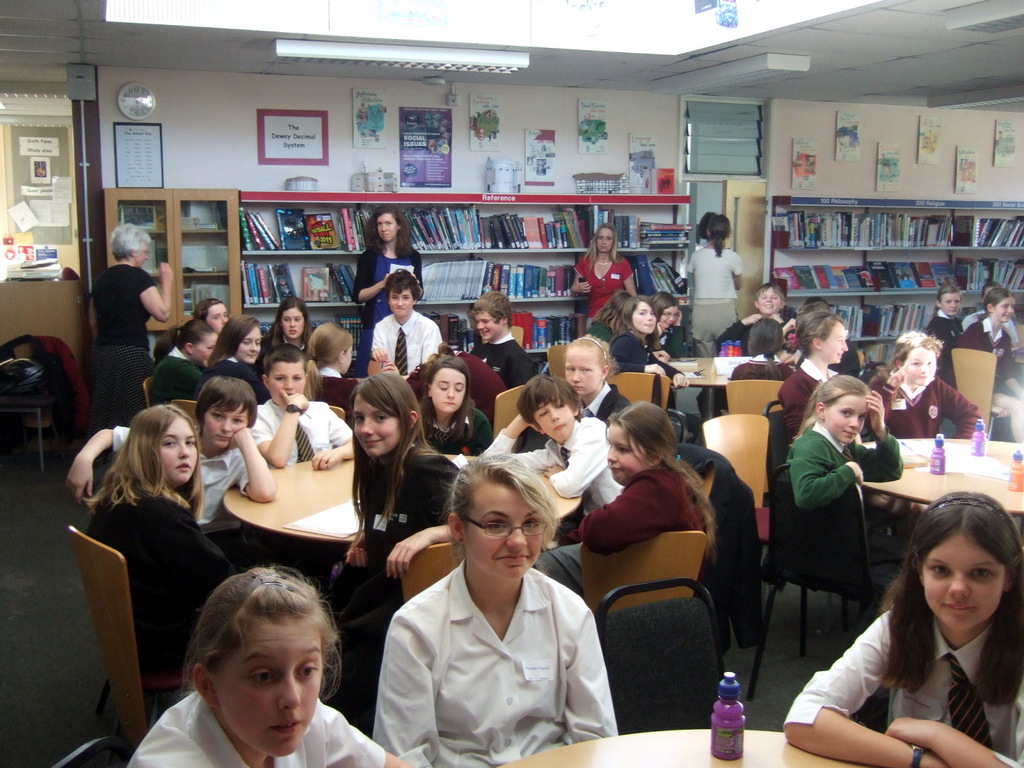
  • Don't just describe the plot. Beginner's mistake - just describing the book. I can get this from the blurb on the back. Sure, in a longer book review, a brief description that sets the book in context is appropriate, but don't describe the whole thing.
  • Use all the senses. Close your eyes, did the book conjure up sights and smells, textures to touch. These kinds of descriptions make the book become real in the eyes of the review reader.
  • Book reviews are a kind of selling. Whether you like a book or not. If you thought the book was 'so-so' then fair enough. But so many books are published, so many great authors fail to make it, that if you truly loved a book it might be your review that makes the difference. Successful selling is all about the transfer of emotion - so put your passion and enthusiasm into the review, and let the reader be in no doubt that you loved a book - or didn't!
Obviously there may be things you have to include in a book review (that your teachers say you have to) - but hopefully this'll give you some more ideas too.


The book I talked about as an example was "All Fall Down" by Sally Nicholls. It's very good.

Oh, and I threatened to publish these too...


Joint Abingdon Schools' Author Visit 2012: The 2 Steves

One of the highlights of the year for us is getting involved with the annual Joint Abingdon School's Author Visits. These take place at different schools every year around Abingdon, are triumphs of organisation and logistics, and inspirational to boot as authors strut their stuff and inspire hundreds of children over multiple (and extremely intense) sessions throughout the day.
Following previous years spent in the company of Julia Golding and Marcus Sedgwick, this year it was the turn of the energetic writing duo The 2 Steves, aka Steve Barlow (or Barlow-beard as he likes to say, to distinguish him) and Steve Skidmore. They performed in front of over 500 children, covering a vast range of subjects that had their audience by turns enthralled, by turns snorting green stuff out of their nose with laughter.
They talked about the process of writing, the power, magic and creativity of writing, some interesting secrets about 'what it's like to be a boy', and a fair amount of grisly details from their iHorror, iHero and Luke Challenger books.

The 2 Steves are ex-teachers and know what kids want to hear. They have been writing for 20 years, and between them have written over 130 books. With a background in helping reluctant readers the books have a definite appeal to boys - but have plenty of fans of both genders.

(Incidentally, I'd have loved these books when I was growing up. I spent far more time than was healthy in the company of Steve Jackson's Warlock of Firetop Mountain and the rest of those 'choose your path' series, so the iHorror 'choose you fate' books would have been right up my street)

Once again, a big thank you to various schools for inviting us to run the bookshop on the day. And the 2 Steve's graciously gave us some time between sessions (whilst glugging tea and scoffing biscuits) to answer some questions about their writing life...

Five questions with . . . The 2 Steve's writing life

1. What are you working on at the moment?
(SB) We're currently been working for two years on a series called "Action Dogs" - sort of Thunderbirds meets Wallace and Grommit. (SS) These are going to be a lot of fun, superbly illustrated by Mark Chatterton, with a group of dogs living in a dog pound, and when the signal sounds, they disappear underground to get their gadgets - such as the bonecoptor - to rescue humans. The first one comes out in August.

2. What is the best writing tip you've ever been given?
(SS) Read lots. Don't give up. (SB) In terms of technical advice, it's a little bit different for us in that we write as a team. (SB) We always plan our books (usually from the end back) and we will bring different ideas together. (SB) We don't really understand writer's block (have you ever heard of a plumber having 'plumber's block?'). The other difference for us is that we tend to act as each other's editor - so our writing actually doesn't need too much editing at the end. For example, with the Luke Challenger series, once you get to the third book in the series (Return to King Solomon's Mines), you know the characters well, and aside from the plot twists, you are pretty confident the books will work.
We don't really have a writing style either - more a 'project' style. We write for our audience, and this reflects our background as both teachers - and teachers involved with getting dyslexic kids to read (both have written books for Barrington Stoke - http://www.barringtonstoke.co.uk/author.asp?mid=351) 

3. What's the best and worst thing about being a children's writer?
(SB) The best thing is being able to see how your book has been received, getting lots of feedback. Kids tend to be forthright and honest - but usually very generous. I think with adult writing you don't get that so much, perhaps a bit at literary festivals. (SS) You do many more talks with kids, often two or three a day, so the capacity is there for more feedback. The other thing which is quite liberating as a children's writer is that constraints you operate under are a strength. When writing an adventure, we can focus purely on the page-turning, exciting adventure of it all - without a lot of the baggage that comes with adult writing. If a character is nasty, they don't need to be foul-mouthed, for example.

(SB) One downside though is when an idea hasn't worked. You very soon know about it,  it becomes obviously very quickly because the kids tell you!

4. Do you have a writer's survival kit?
(SS) Not really. If anything, we are each other's survival kit! We're on the road so much, that we constantly spark off each other with ideas, and often editing/reviewing material. Particularly if a deadline is looming. But we tend to write at home. We are Mac boys, and even if we're not in the same room we'll use web cams to collaborate when we are writing.

5. What was your big breakthrough? 
(Both look a bit startled, and look at each other) I don't think we have one - we're still waiting!