Showing posts with label writing life. Show all posts

After I Launched You: Alison Mercer and the launch of 'After I Left You' at Mostly Books

Second chances - and facing up to the past so you live in the present - are two of the big themes in Alison Mercer's second novel 'After I Left You'.

Alison was at Mostly Books on Thursday to celebrate its launch. Friends, family, fans and colleagues listened as she explained the genesis of the book, how it been in her mind as an idea for years.

But the story of Anna and how she comes to terms with bruising realities in her past, was the one her editor most wanted to see after a meeting to discuss publication of Alison's first novel 'Stop the Clock', in what Alison described as being 'like the most scary job interview ever'.

Alison thanked her husband, Ian, for his support in giving her time to write, to her supportive team at Transworld and also the support of her work colleagues and other writing friends. There were at least two extremely well-known authors in the audience, as well as editors, agents, bloggers - including the Abingdon Blogger.

She read from the opening scene, one in which Anna bumps into an old flame. Her attire, the bridesmaid dress in her hands, makes this excruciating, a bad-dream sequence that she would never have wanted to happen.

In a similar way to 'Stop the Clock' the action catches up with university friends after time has passed and analyses how their lives have fared - who made good on early promise, whose marriages are on the rocks, who is no longer even around. The Oxford setting ensures plenty of local appeal, but the themes - and the writing - ensure that appeal is universal. But the style has a definite darker side - and a creeping sense of unease builds imperceptibly as past history slowly bubbles to the surface.
'After I Left You' features a compelling mix of characters, back stories seamlessly woven in and will appeal to anyone who ever attended a reunion and couldn't help but measure up against all their old protagonists.

For Anna, life started off well, heading to Oxford from an ordinary background and falling in with a glittering group of privileged friends. Bumping into old-flame, Victor, seventeen years after she last saw him is painful enough. But Anna must brave seeing all her old group again as she tries to lay to rest the time she has not ever really moved on from - the time when she realised her friends were not all they had seemed...

Once again the weather played ball allowing us to hold another magical evening in the garden. Following the launch of her debut in 2012, we were honoured to host the launch of 'After I Left You', to welcome so many great supporters of Alison to the shop - and a huge thank you to Transworld for supporting their author and the event so strongly.

(Find out much more about Alison and her writing here)

Alison is - as the publishing world demands - already writing her next book. So we are definitely looking forward to another launch event. As Dorothy Parker said "I hate writing, but I love having written". And we love having launched a new book!

Disgraced spooks and Dead Lions - an evening with Mick Herron

It’s the sort of story everyone loves to hear – an author who suddenly hits the big time and wins a major prize just at the point he thinks his writing career is in trouble.

Crime writer Mick Herron, who won the 2013 'CWA Goldsboro Gold Dagger' for the Best Crime Novel of the Year, was at Mostly Books on May 21 to talk about two books set in the murky world of disgraced spies.

‘Dead Lions’, his prize-winning novel, is a wryly humorous tale of disgraced MI5 spies, who have been sent to Slough House as they can’t be sacked. Consigned to dull desk work, they are desperate to find a way back to the field work where they think they belong.

When a Cold War spook is thought to be active again, they suddenly have a chance of glory. But after years of being out of the game and all despising each other, there is as much comedy as action as we watch them all creak back into life and try to form a team that has even half a chance of getting results.

Mick Herron explained how, as his UK publisher wasn’t interested in the book, he thought his writing career was over. But then his US publisher stepped in, said they would take it on – and submitted it to the Crime Writers’ Association annual awards.

He beat a hugely impressive shortlist, including the much-lauded ‘The Shining Girls’ by Lauren Beukes, and Belinda Bauer’s ‘Rubberneckers’, among others, to take the dagger. In doing so he joins illustrious names such as Ian Ranking, Val McDermid and Reginald Hill as previous winners of the award.

At an evening at Mostly Books, Mick explained how the inspiration for his two very clever and funny crime novels was all sparked by a decrepit building he passed daily on his way to work that got his imagination going.

It may have been a building that sparked the initial idea, but Mick said he always starts with characters and a situation with his writing and finds his best plotting ideas develop as he goes along. And Slough House is peopled with some great characters – with tales of just how exactly they were disgraced leaking out throughout the books.

His journey towards his gold-dagger award-winning success has not been smooth. It took two years for this first novel to find a publisher in 2003 and he still only writes in the evenings after coming home from a full-time job.

It takes him about 18 months to write a novel - a slow process that involves more editing than writing and a great many semi-colons. But he has always written and always looks forward to that moment every day when he can get down to some writing.

‘Writing is an addiction you have to nurture. Most addictions you try to wean yourself off, but with writing you have to take that urge and encourage it and do it every day. I can’t wait for the part of the day when I switch my laptop on,’ he said.

With books involving such intriguing plots and such a large cast of characters, all of whom have a life of their own, he took plenty of questions about his writing style. He plots the first chapters scene by scene and only researches if he gets to a point in the plot where he feels he needs to.

The next step is that not only will he see all his previous novels back in print after his Dagger success – there will be a new standalone noir thriller, before he turns back to the folk at Slough House after that.

With a television series in the pipeline, we really hope far from a publishing career being over, that Mick is actually only at the start of a very successful career indeed.

Of Best Friends and Favourite Cheese: Susie Day and the 'Life of Pea'

Author's get asked the best questions when they visit primary schools. Once you push past the common questions of 'Where do you get your ideas' and 'Who was your favourite author' you tend to get less obvious questions.

Questions such as 'what would you have done if you hadn't been a children's writer?' or even 'what's your favourite cheese?'


Susie Day - author of 'Peas Book of Best Friends' - handled these and other questions brilliantly talking to pupils from Dunmore Primary School and Carswell Community School.


Susie took the children on her journey to becoming a writer, starting with her desire to be a children's character (Lucy from Narnia, a Moomin, etc.) through to her hopelessly romantic idea of what a writer was (quill pen, castle, etc.) before explaining the reality of writing (scribbled notes in between changing nappies, sorting post and being a tour guide).


For those budding writers in the audience (and there were plenty more I suspect once Susie had finished) she took them through the basics of character, setting and plot - before getting children to guess what was in the box as a way of getting ideas to start telling a story.

There was audience participation too: volunteers were asked out the front to tell the story of Pea, her Mum and two sisters. She confessed that the idea for Peas Book of Best Friends was sown by thinking about JK Rowling, and in particular what it must have been like for her eldest daughter suddenly finding herself with a very famous writer Mum...


The children at both schools had prepared brilliantly, and were a hugely attentive and engaged audience.

(What was particularly thrilling to discover was that Dunmore has a Friday afternoon writing activity called "Write Here, Write Now" in which children are encouraged to do free writing for 30 minutes. It's a great initiative - and we could definitely spot a few budding authors in the queue to meet Susie after the event.)


A huge thank you to both schools for being such wonderful hosts, to the children for giving Susie such a warm and enthusiastic welcome - and of course to Susie for revealing so much about her writing journey and giving such an inspirational and entertaining talk.

As always - we made sure Susie gave a little more insight into the writing process, and we asked her five little questions...

Five questions with...Susie Day's Writing Life

1. What are you working on at the moment?

I am currently writing Peas Book of Birthdays. It's due on July, so I have until the end of January to finish it!

2. What is the best writing tip you’ve ever been given?

"Writing is re-writing" - lots of people have said this, not sure who said it originally though! But it's great advice.

3. What’s the best thing and the worst thing about being a children’s writer?

The best is getting to work in your PJs (not sure you should write that) - and of course going to schools, meeting your readers - which is a joy. The worst is when the writing is going really badly, you have no ideas in your head, and you think 'I can't do this'. This happens a lot during the writing process incidentally!

4. Do you have a writer’s survival kit, eg a place, thing of snack essential before you can start work?

Tea! And lots of it! In my big special mug. And Ceylon tea if possible (you get the idea!)

5. What was your biggest breakthrough?

It was when I won a competition, the BBC Talent Children's Writer's Prize 2004. This was the first time I had shown my writing to anyone, and also the first time I had told people in my family I was writer. Everything flowed from there.

Joint Abingdon Schools' Author Visit 2012: The 2 Steves

One of the highlights of the year for us is getting involved with the annual Joint Abingdon School's Author Visits. These take place at different schools every year around Abingdon, are triumphs of organisation and logistics, and inspirational to boot as authors strut their stuff and inspire hundreds of children over multiple (and extremely intense) sessions throughout the day.
Following previous years spent in the company of Julia Golding and Marcus Sedgwick, this year it was the turn of the energetic writing duo The 2 Steves, aka Steve Barlow (or Barlow-beard as he likes to say, to distinguish him) and Steve Skidmore. They performed in front of over 500 children, covering a vast range of subjects that had their audience by turns enthralled, by turns snorting green stuff out of their nose with laughter.
They talked about the process of writing, the power, magic and creativity of writing, some interesting secrets about 'what it's like to be a boy', and a fair amount of grisly details from their iHorror, iHero and Luke Challenger books.

The 2 Steves are ex-teachers and know what kids want to hear. They have been writing for 20 years, and between them have written over 130 books. With a background in helping reluctant readers the books have a definite appeal to boys - but have plenty of fans of both genders.

(Incidentally, I'd have loved these books when I was growing up. I spent far more time than was healthy in the company of Steve Jackson's Warlock of Firetop Mountain and the rest of those 'choose your path' series, so the iHorror 'choose you fate' books would have been right up my street)

Once again, a big thank you to various schools for inviting us to run the bookshop on the day. And the 2 Steve's graciously gave us some time between sessions (whilst glugging tea and scoffing biscuits) to answer some questions about their writing life...

Five questions with . . . The 2 Steve's writing life

1. What are you working on at the moment?
(SB) We're currently been working for two years on a series called "Action Dogs" - sort of Thunderbirds meets Wallace and Grommit. (SS) These are going to be a lot of fun, superbly illustrated by Mark Chatterton, with a group of dogs living in a dog pound, and when the signal sounds, they disappear underground to get their gadgets - such as the bonecoptor - to rescue humans. The first one comes out in August.

2. What is the best writing tip you've ever been given?
(SS) Read lots. Don't give up. (SB) In terms of technical advice, it's a little bit different for us in that we write as a team. (SB) We always plan our books (usually from the end back) and we will bring different ideas together. (SB) We don't really understand writer's block (have you ever heard of a plumber having 'plumber's block?'). The other difference for us is that we tend to act as each other's editor - so our writing actually doesn't need too much editing at the end. For example, with the Luke Challenger series, once you get to the third book in the series (Return to King Solomon's Mines), you know the characters well, and aside from the plot twists, you are pretty confident the books will work.
We don't really have a writing style either - more a 'project' style. We write for our audience, and this reflects our background as both teachers - and teachers involved with getting dyslexic kids to read (both have written books for Barrington Stoke - http://www.barringtonstoke.co.uk/author.asp?mid=351) 

3. What's the best and worst thing about being a children's writer?
(SB) The best thing is being able to see how your book has been received, getting lots of feedback. Kids tend to be forthright and honest - but usually very generous. I think with adult writing you don't get that so much, perhaps a bit at literary festivals. (SS) You do many more talks with kids, often two or three a day, so the capacity is there for more feedback. The other thing which is quite liberating as a children's writer is that constraints you operate under are a strength. When writing an adventure, we can focus purely on the page-turning, exciting adventure of it all - without a lot of the baggage that comes with adult writing. If a character is nasty, they don't need to be foul-mouthed, for example.

(SB) One downside though is when an idea hasn't worked. You very soon know about it,  it becomes obviously very quickly because the kids tell you!

4. Do you have a writer's survival kit?
(SS) Not really. If anything, we are each other's survival kit! We're on the road so much, that we constantly spark off each other with ideas, and often editing/reviewing material. Particularly if a deadline is looming. But we tend to write at home. We are Mac boys, and even if we're not in the same room we'll use web cams to collaborate when we are writing.

5. What was your big breakthrough? 
(Both look a bit startled, and look at each other) I don't think we have one - we're still waiting!

It's beginning to look a lot like Hugless...

When you come into Mostly Books, there are a few 'signature' books, ranges and authors that people have got to know us for over the years. Our Persephone Books have been a feature of the shop since we opened, and favourite authors of the staff tend to do well on the shelves too: Reginald Hill, Neal Stephenson, Brandon Sanderson and a few others we have more than a soft spot for.

Amongst shrines to authors in the children's room, you'll find Catherine Rayner, Julia Donaldson - and local children's author David Melling.

We've known David for many years, and recent events with him have seen a drawing masterclass at the local library, and also a splendid make-your-own-Douglas event that took place in the courtyard garden. But what has been really exciting is to see how 'Douglas' has really taken off and quickly won a place as a modern classic, shortlisted for plenty of awards, even spawning a hugely popular and pioneering smartphone app (itself up for awards).

Douglas has featured rather largely in the shop window for the last few months:


Hodder have done a great job turning Hugless into a very cute plush together with the book. Just look at his little nose and scarf:

David recently came into the shop to kindly sign copies of his books for us, and we took the opportunity to ask him a few questions about his writing (and drawing) life...

Five questions with . . . David Melling's writing life
1.    What are you working on at the moment?
'We love you Douglas' the fourth Douglas book, then I’m taking a break from Douglas. I’m then working on a new character, not entirely sure of his name, but probably called ‘Warren’. It’s going to bit more slapstick humour than Douglas, a bit of a change of pace. The feedback from my publisher in terms of what they like about my work is my characters: they like the pathos, humour and the strength of character – and Warren will focus on all of these elements.

2.    What is the best writing tip you've ever been given?
I think my knee-jerk response to that question is: do a little each day. It’s very important. Kids often ask me ‘how do you do that?’ when I draw, and it all comes down to a little each day. It’s like learning to play a musical instrument or a sport. You don’t pick up your tennis racquet one day and be volleying, hitting winning shots the next. The more you practice the better you get, and that’s the same with drawing and writing.

3.    What's the best and worst thing about being a children's writer?
The best thing is to be able to sit down and write and draw all day long. I’m very lucky, and there is nothing better. The worst aspect is towards the end of a project however, you do long and unusual hours, you neglect your family. That can be tough.

4.    Do you have a writer's survival kit?
Well, I did hear that Andrew Motion finds Lemsip gets him all creative, and Agatha Christie apparently used to bathe in a hot bath with apples, and the aroma inspired her! If I’m stuck, I’ll go for a walk, or drive, in fact – just get moving. I find train journeys are very useful in that regard. I do a lot of work in coffee shops, just doodling when ideas come. I always have a sketchbook on me, and so can always write stuff down.

The cartoonist James Thurber once said the hardest part of his job was convincing his wife that when he was standing and staring out the window he was actually hard at work. And that’s true. When I’m sitting and staring out of the window, having a meditative moment, that’s when ideas come. It links back to the joy of the job, at any point – whatever I’m doing – I can pull back from reality a little, and dip into the writing well.

5.    What was your big breakthrough?
I had two big breakthroughs. The first was in my 20s, when I was introduced to an illustrator who lived a couple of streets away. I was very lucky, and for a year I apprenticed to him, and was able to build up a portfolio. If you have the opportunity to apprentice to someone great, it’s very fortunate, and a wonderful opportunity - but to find someone nearby in the same town was incredibly lucky.

Breakthrough number two was whilst working at an animation studio. I had been building my portfolio up, and realised that my big passion was children’s books. At the time I made this decision and starting to look around, I was introduced to someone who had just set up on her own as an agent, and was looking for clients. It was perfect timing, and although it took almost two years to get published, having guidance within the industry was incredibly useful. I’m happy to say that – nearly twenty years later – she is still my agent!

---

For more insights into David's writing life, visit his rather splendid website here. And if you are a young fan of Douglas, you can vote for him in the Red House Children's Book Awards here. And of course, we have signed copies of Douglas (including rarely signed copies with the plush) in the shop. Just email books@mostly-books.co.uk if we can send you a last minute, rather special Christmas present...

Turning Real-Life Stories into Books - with added imagination from Frank Cottrell Boyce

What if you had a car that could fly? What would you do if you found a bag full of money?

The imaginations of more than 200 schoolchildren from more than five Abingdon schools were given a jump start on Wednesday Nov 30 as they listened to multi award-winning children’s author Frank Cottrell Boyce talk about the inspiration behind his books.


Frank read from his latest novel ‘Chitty Chitty Bang Bang Flies Again’ and told how the roots of the story grew from real life.

Ian Fleming is well known as being the creator of James Bond, but fewer people know that he was the creator of the original children’s story ‘Chitty Chitty Bang Bang’ . Even fewer would have known that the story was inspired by a real car.

Ian Fleming saw Chitty Chitty Bang Bang race when he was a young boy – and that memory came back to him when - convalescing from a heart attack - it formed the inspiration behind his only children’s book.

Frank Cottrell Boyce told the amazing story of a rich count who came into his money very young and spent his money on things most children couldn’t even dream of. Things like a full-size train track in his grounds to race trains, and putting a zeppelin engine in a car - the original Chitty - to race it at Brooklands (it could go over 100mph).

Frank Cottrell Boyce’s first books are all based on what children would do when placed in extraordinary situations. ‘Millions’ is about what a couple of boys decide to do when they find a huge amount of money. And ‘Cosmic’ is about a 12-year-old boy who looks much older and gets mistaken for an adult.


These stories have been loved by children, turned into films, and means Frank Cottrell Boyce has been on every major award for children’s writing.

In Frank Cottrell Boyce’s ‘Chitty Chitty Bang Bang Flies Again’ – the original Chitty’s engine is reassembled (without the family’s knowledge) inside a camper van. So when they set off, their trip around the world is like no other.

Frank also shared loads of stories and advice about how simple things can become stories if you add a lot of imagination and a little magic – and talked about all the things that inspired him to become a children’s writer.


He knew he wanted to be a writer from when he was at school and a teacher read out something he’d written to make a friend laugh – and he made the whole class laugh.

‘I learned that if you choose words in the right order people will laugh even if you’re not there in person. Someone could be laughing at the same thing even all the way in China. Writing is like having a superpower.’

His incredible talk ended with so many hands bristling with energetic questions for the author he could have been there all day.


Note to other booksellers: If you’re going to organise a big author event involving lots of schools – don’t organise it on a day when there is a big strike on and lots of schools are going to be closed.

But do organise it with author Frank Cottrell Boyce. Because even if the whole event has hung in the balance – it can still turn out to be a tremendous day that makes several sleepless nights truly worthwhile.

A huge thank you for all the schools and teachers who turned out in force to keep the event going.

And a big thank you to everyone who came to the shop to meet Frank at Mostly Books afterwards. Particularly to Jo and Rosie Caulkin who travelled from Birmingham to meet him.

Five questions with . . . Frank Cottrell Boyce's writing life
1.    What are you working on at the moment
'Chitty Chitty Bang Bang 2' (looks nervously at his editor sitting across the table from us). No, of course, that's finished. Chitty Chitty Bang Bang 3!

2.    What is the best writing tip you've ever been given?
Read, read, read.

3.    What's the best and worst thing about being a children's writer?
The best thing is the contact with children. Watching them meeting an author, getting questions. It's very real, very visceral. The worst thing is that, you do so many events that you end up having no time to write. You can't do events half-heartedly, every event I do I put everything into, I don't want to let anyone down.

4.    Do you have a writer's survival kit?
No - nothing. My house is so busy, and I am so busy, I write anywhere, at any opportunity. Edith Nesbit (and also PG Wodehouse) used to write at parties. In fact, that's a great tip for writers: learn to write at parties!

5.    What was your biggest breakthrough?
I had written the script for ‘Millions’, and Danny Boyle told me "I'll do the film, but you must write the book". And that was the nudge I needed. I think writers need to have other people give them a shove to get a book out there.

One enchanting evening: Kevin Crossley-Holland

It is doubtful to be able to think of another writer writing today who celebrates so wholly, the long traditions of story-telling, as Kevin Crossley-Holland.

At an event hosted jointly by the Oxford Children’s Book Group and Oxford Brookes, Kevin Crossley-Holland, who has recently published an autobiography of his childhood, described his journey to becoming a writer.


He places its origins not simply down to sharing stories of myths and folk tales with his father, but also to a love of history – which fired him up as a boy, to transform his garden shed into a museum. People brought him artefacts discovered locally or from home. And his grandfather had collected treasures that were so precious he had offers from the British Museum.

It was an accident which closed the door to a possible sporting career, resulting in a lot of time recuperating, that than transformed his studies into a proper appreciation and a love of language – particularly Anglo-Saxon.

One of his first works was a translation of Beowolf (he started writing poetry in his youth), which he started when at Oxford University.

But a full-time writing career didn’t beckon until two mentors he had met in Oxford, encouraged his decision to give up his job in publishing to research and write a book of Norse myths.

And those mentors were JRR Tolkien and WH Auden.

Of course he has gone on to not only be shortlisted for the Carnegie Medal, but to be the only writer ever to have won with a book for younger readers ‘Storm’. He called for the judging criteria to be split, as so many novels published are for older readers, meaning primary school teachers are left lamenting the fact that there is never room for the best writing for younger readers.

But even all this did not make it easy for Kevin Crossley-Holland to write the book he is best known for his King Arthur trilogy, which starts with ‘The Seeing Stone’. This was a project he had thought about and planned for years but could not find a way to approach, until he was commissioned to write it and had already spent his advance before he started to do the actual writing.

Here, he gave an insight into his writing life. Answers are under our own noses, he said and offered plenty of tips about how to approach work, how to get inspiration and ideas, and how to weave your own knowledge and research into a narrative world children can enter.

Why should our first thoughts be the best, says the author, who spends about 40% of a book’s journey in the planning, thinking and getting to know a character, then about 20% of the time in rapid writing and about the last 40% in drafting and revising.

In answer to a question about whether he could put his finger on why stories were so important, the author was in no doubt. He believes it is important for children to know stories because is that it is part of a genetic heritage. This is why we are so able to suspend our disbelief, because it is through stories that we learn to be human, to feel sympathy, joy, or excitement for another person – through reading about what happens to a character we learn empathy.

Five questions with . . . glimpses of Kevin Crossly-Holland’s writing life
1.   What are you working on at the moment?
I am completing the second in the Viking trilogy ‘Scramasax’. I always write poetry. And I am going to do a picture book with Jane Ray about Vivaldi.

2.    What is the best writing tip you’ve ever been given?
It is a job of work and a matter of getting down to it and not waiting for inspiration. It’s all about thinking of writing as a discipline. It’s also about going that extra mile – writing something and thinking even as you write it that it won’t wash – you have to take risks and go for it. Actually, I am better at doling out tips than receiving them.

3.    What’s the best thing and the worst thing about being a children’s writer?
It is probably having children writing to you, sometimes even long after they read something, and tell you that something you’ve written really counted. That and the smiling faces of children when you meet them. There really isn’t a worst. It is a gloriously rewarding job.

4.    Do you have a writer’s survival kit, eg a place, thing of snack essential before you can start work?
Well I am extremely pernickety and I go around my study tidying imaginary things away and checking that my pens have got a refill and just about anything to defer starting work.

5.    What was your biggest breakthrough?
In terms of critical esteem is was ‘Storm’ (which won the Carnegie Medal) and in terms of sales it is the Arthur trilogy, which has been translated into 25 languages.

Book frenzy week!

It’s been a week of hurtling through book-related celebrations that has left us feeling exhilarated at so much enthusiasm for books, exhausted – and suffering from a severe case of bookshop envy.
Recovering as we were from the previous week’s excitement with Cathy Cassidy – and Our Lady’s school in Abingdon hosting their first book festival (with more than an author a day visiting the school) – on Thursday we were up and ready to run a bookstall for the Oxfordshire Book Award ceremony – 300 children, 5 authors and a lot of cake.

With only about half an hour to transform a school dining room into a book buying and signing palace, it was a race against time to deliver, unload and unpack 25 boxes of specially chosen titles – from all the current new crop of interesting writers, bestsellers – but, primarily titles from no fewer than five guest authors at the Oxfordshire Book Award ceremony.

The Oxfordshire Book Award is run among primary and secondary schools in Oxfordshire with the aim of encouraging reading and lively debate about reading. And if the enthusiasm for book buying is any sort of gauge of success – all this encouragement has definitely created a severe case of bookitis among all the pupils who attended.


There was certainly a lively enough atmosphere as we served up books at the same time as the children were served up afternoon tea refreshments at Abingdon School, following an afternoon of listening to the guest speakers. There was a chance for children to meet some of the prize-winning authors, as well as guest authors Jo Cotterill, SL Powell and Sally Nicholls.
Award-winning author Malorie Blackman (winner of Secondary School Category for ‘Boys Don’t Cry’) was kept busy signing and meeting her fans.

Axel Scheffler, best-known as illustrator of The Gruffalo, won Best Picture Book (Primary School Category) for ‘Zog’, and the queues for him didn’t die down until everyone had to be dragged back to school for the end of the day.

The awards are judged by children across schools in Oxfordshire. They also picked Michael Morpurgo’s ‘Shadow’ as the winner of the Primary Book award.


Our sincere thanks to Gabby, Jo and Sally for their assistance in manning the bookstall. I don’t suspect for a minute they knew what they were letting themselves in for, but it was too late to prepare them when someone suddenly yelled ‘they’re coming’ and the next 40 minutes went by in a blur of recommending titles and scrabbling to find enough one pound coins.

The atmosphere wasn’t much less frantic at the opening of Barefoot Books in Summertown (piccies below).

The whole place is enticing enough to host a children’s party, let alone some storytelling. It’s a beautiful space for selling books.

It’s wonderful to be able to add Barefoot to the list of Oxfordshire booksellers and we hope their incredible programme of events means many people will make the trip to Summertown and fall in love with Barefoot Books.

We were lucky enough to grab a little time with two of the authors on Thursday – our thanks to Sally Nicholls and Jo Cotterill.

Five questions with . . . Sally Nicholl’s writing life
Sally Nicholls is the author of two books. 'Ways to Live Forever' is about a boy with leukaemia, and won the Waterstone's Children's Book Prize. It is currently being translated into sixteen languages. 'Season of Secrets' is based on the pagan myth of the green man.

1.    What are you working on at the moment?
I am trying to put together a submission for my next book. I am at a really very early stage with putting together my ideas and it might be a ghost story. I’ve also been commissioned to write two books for Barrington Stoke, who publish books for reluctant readers.

2.    What is the best writing tip you’ve ever been given?
To learn from writers that you love, but not to try to write the same book as they would write – that way your book will only ever be second rate. You have to write the book that only you can write. You have to write about the things you love.

Also – that the first draft won’t be any good, but that is a good thing. A first draft can be as rubbish as you like and this is a positive thing because what’s important is that you have got it written and can start to work on it.

3.    What is the best thing and the worst thing about being a children’s writer?
The thing that I like is that you have a lot more freedom. You can write a realistic book and a historical book and they will sit together on a bookshelf. What I don’t like is the fact that a book takes so long to write, it takes several years to finish a book and you are on your own in front of a computer.

4.    Do you have a writer’s survival kit, eg a place, thing or snack essential before you can start work?
I am definitely a procrastinator, I always think a cup of tea would be nice, so for me it helps if I am somewhere else – someone where I know I am there because I am supposed to be writing. I like best to be writing with other people. Getting two or three people together in the same room who are supposed to be writing really works for me because you don’t want to be the one who’s not writing.

5.    What was your biggest breakthrough?
It never really felt like I had a breakthrough, more a series of stages. Firstly, getting on an MA course, finding an agent, then a publisher. I had five publishers interested in my first book, so probably my biggest breakthrough was when a publisher actually said they would pay me some actual money. That meant I was able to write and just work part-time three days a week.

Five questions with . . . Jo Cotterill’s writing life
Joanna Kenrick published her first book, Moondance, a picture book for young children, in 2004. Since then, she has published many different books for teenagers and young people, including her young adult novel Red Tears, a story about a teenage girl who turns to self-harm. She also writes a series of books for 9-13s called Sweet Hearts under the name Jo Cotterill.

1.    What are you working on at the moment?
Book 6 in the Sweet Hearts series, which will be the last Sweet Hearts book! It’s due out in June 2012 and is about a synchronised swimmer competing in the Olympics.

2.    What is the best writing tip you’ve ever been given?
Read, read, read

Write, write, write

I can’t remember who said it, but, to me, it sums up everything an aspiring writer needs to know.

3.    What is the best thing and the worst thing about being a children’s writer?
Best thing: being paid to make up stuff!

Worst thing: constant worry about money . . .

4.    Do you have a writer’s survival kit, eg a place, thing or snack essential bfore you can start work?
Empty house! Absolutely essential!

5. What was your biggest breakthrough?
Getting an agent for my YA novel ‘Red Tears’. It was the first time I really believed I could have a career in writing.

Marshmallow Skye: The Dreamy Cathy Cassidy

Don't get me wrong, I don't have a 'thing' for Cathy Cassidy (well, not that I'm fessing up to on the blog, anyway). But I do use the term 'dreamy' deliberately, because if there is one thing that Cathy does a lot of, it's daydream. She cites it as one of the best things about being a children's writer (see below), she claims it to be a crucial element of her writing success - and she advised all the children to do it at a buzzing author event held at King Alfred's in Wantage on Tuesday.


This was maybe not want the teachers wanted to hear. She imagined daydreaming being on the timetable, or a special daydreaming room where children would lounge around on sofas and beanbags, in surrounding of calm and plush carpets, with the teachers bringing smoothies and chocolate-chip cookies.


The response from the children was, overall, fairly positive.

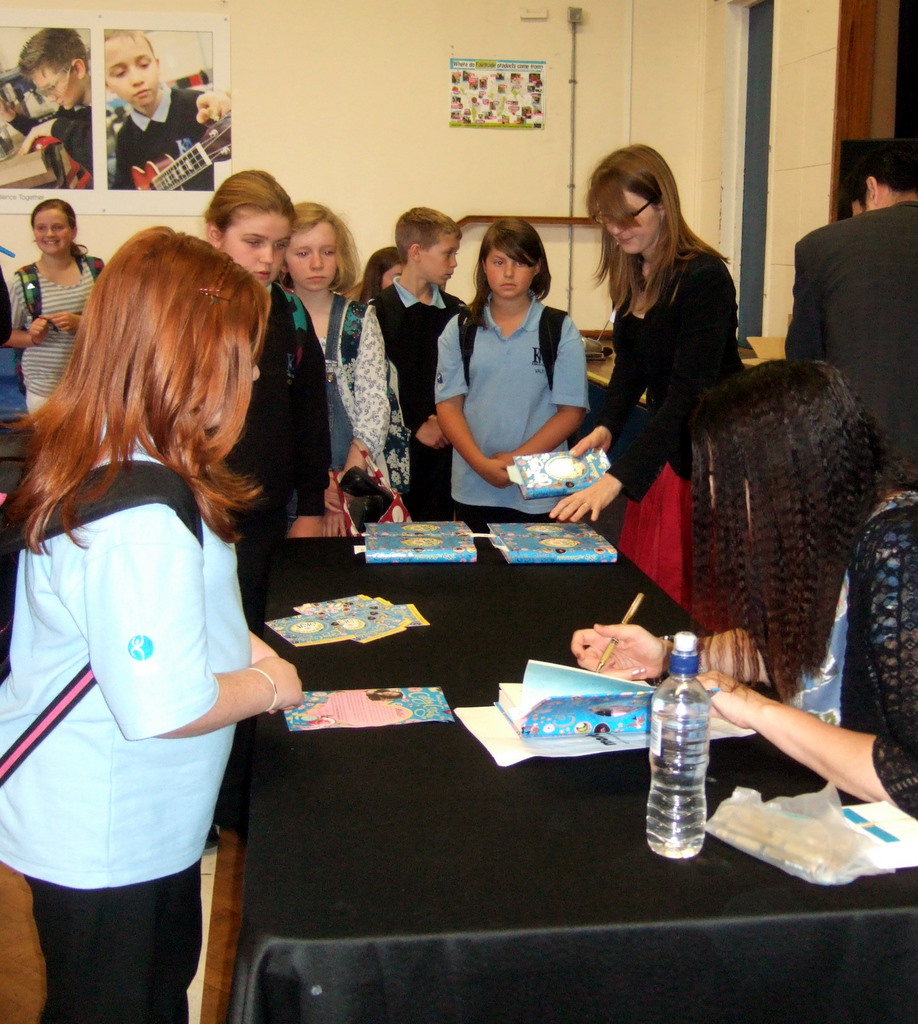
Cathy came to Wantage as part of a staggering 2 or 3 event-per-day, 17-day tour as part of the launch of the second book in her Chocolate Box Girls series Marshmallow Skye. The hall was packed with nearly 300 students, and many had come dressed as their favourite character from one of Cathy's books.


Cathy took time to explain about her life as a writer (shed at bottom of garden, as well as a story 'teepee' which looked very cool) and how she came to write. The young Miss Cassidy bombarded the girl's magazine Jackie with 'hundreds' of short stories, so passionate did she want her stories to be published, and so it was perhaps natural that here was where she found herself in her first job.


(Cathy encouraged the children to publish their own school magazine. She also said, if there was already a school magazine, they could start up a rival. So there may be a media boom at King Alfred's over the next few weeks).

Having talked about her writing and her books, she read an extract from Marshmallow Skye. It is no surprise to us at Mostly Books why Cathy is so popular amongst her readers (which, for the Chocolate Box series, is broadly 9-13). The things she writes about are central to the life of her readers: friendships, feelings and quite simply the dilemmas of that simple-sounding phrase "fitting in".


Cathy warned children to 'never trust an author' as they were always on the lookout for shiny things to steal (in the form of story ideas), and then several of the bravest (and I thought this was *very* brave) children who had dressed up performed in a fashion show, across the stage, with the winners receiving some suitably fab chocolatey prizes...


There were some *very* big Cathy Cassidy fans in the audience, who were very excited to queue up afterwards to get books signed.


King Alfred's went to herculean efforts to put on a fabulously-organised event, and our thanks to Cathy for braving a schedule that saw her in Cardiff the day before, and Sheffield that evening!


Cathy also kindly offered to answer a few questions for the blog...so here goes:

Five questions with... Cathy Cassidy's Writing Life
1.    What are you working on at the moment?
I am currently working on the third book in the Chocolate Box series called "Summer's Dream". It's due out next June, and is about Skye's twin sister Summer.

2.    What is the best writing tip you’ve ever been given?
Well, I try to share as many tips as I can in the 'Writing Workshop' section of my website, so definitely take a look at that. But I guess my best tip is to write about what you care about. It shows, it really does. I write about feelings, that's what matters to me. But it could be anything: dragons, vampires, fast cars, anything - as long as it's something you really care about. If you try to write for a gap in the market, children are so sharp, and they are so open and direct, they will realise pretty quickly. Also, if I didn't write what I cared about, I'd have got bored long ago. I wouldn't be able to sustain it over several books.

3.    What’s the best thing and the worst thing about being a children’s writer?
The very worst thing is deadlines, and keeping to them. I think as you become a more successful author, there is more of an expectation to have books published on a faster timescale. I often think I would like a parallel 'me' writing away, whilst the other 'me' is doing all the other things! I'm currently on a 17-day tour, with sometimes two or three events per day, and by the end of the day there is very little energy left to write. On the one day off I had though, I was writing!

4.    Do you have a writer’s survival kit, eg a place, thing or snack essential before you can start work?
I write in a little shed in my garden, and in there I am surrounded by lots of nice things, things that only mean something to me, but which no-one else would give houseroom to! But the main thing for me is my laptop. Just before this tour, my laptop died. It was the middle of the night, I had a dreadful cold, and I had to drive the two hours to Glasgow, put my laptop in the Apple repair shop, get a replacement and start the tour.

I always have a notebook with me though, so that if anything comes to me I can jot it down. I guess the most important thing is just my head, for daydreaming. And luckily I always have my head with me!

5.    What was your biggest breakthrough?
Difficult to say if there was a 'breakthrough' as such, although as soon as the books started to do well, that was very important. But really, it was from making my living as a journalist. My first proper job after leaving art college was on Jackie magazine, and although I started at the very bottom as office assistant, within two years I was fiction editor. This allowed me to discover just what kids like to read about, and how to write stories: how to hook a reader, how to edit stories, how to structure and illustrate them. All that knowledge was incredible. Once I left, I started with short stories (I still love to write short stories BTW - I have one coming out at Christmas) but gradually grew to write books. I love the space the longer format gives you to tell a story.